Essay · TRANSIT
What Happens to Business When You Close a Street to Cars

Your downtown has a retail problem: empty storefronts, declining tax revenue, negligible foot traffic.
The city proposes a solution: close the street to cars, creating a public space for walking and dwelling in the street.
Business owners lose their minds:
- “This will kill us!”
- “No parking means no customers”
- “You’re destroying our livelihoods”
This reaction is understandable.
Business owners have real skin in the game and change is scary for low profit-margin businesses.
Their complaints deserve an answer.
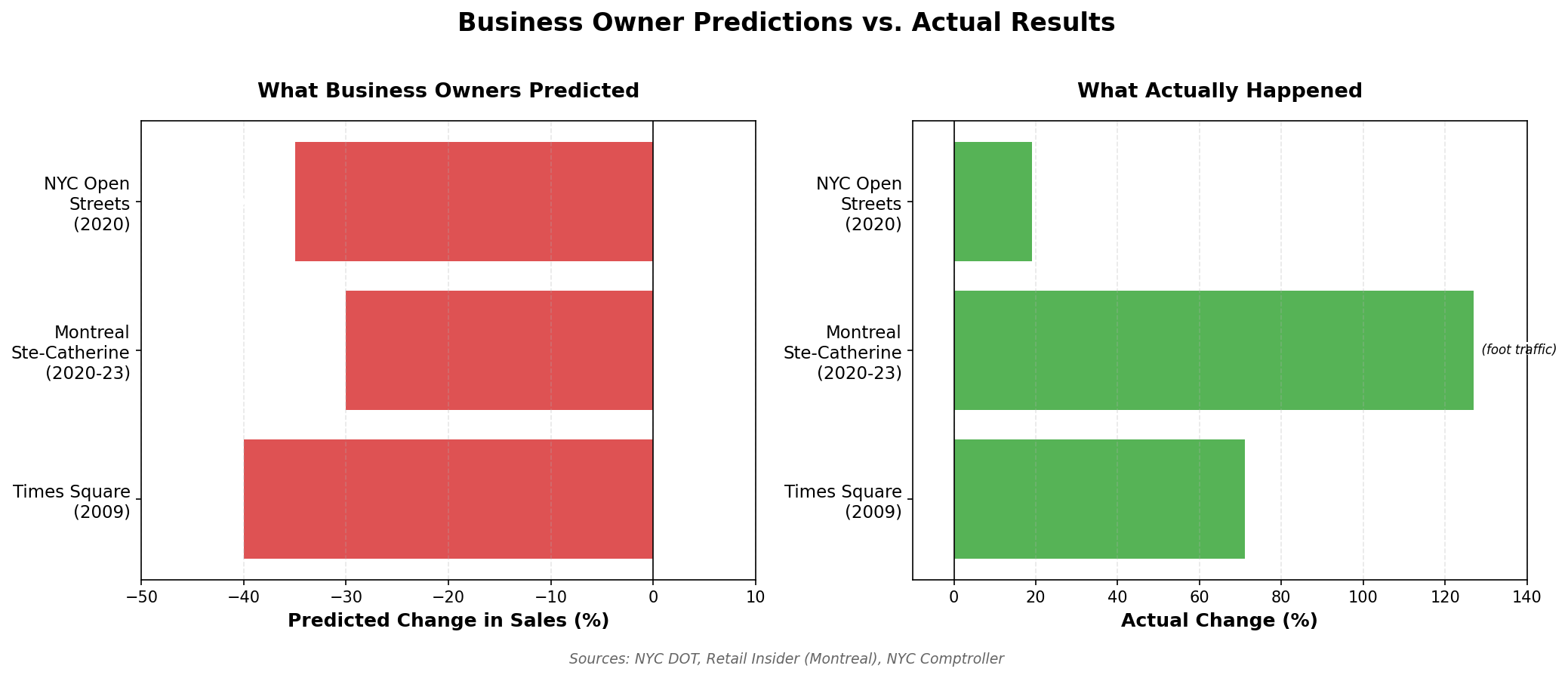
Here it is: in every North American city that has tried pedestrianization, business revenues have increased.
Not most cities: every city.
The Pattern That Never Changes
Two illustrative examples: New York City and Montreal.
Times Square, 2009
New York City announces plans to close Broadway to car traffic between 42nd and 47th Street.1
Business owners oppose it. They are convinced that closing the street will devastate their stores.
What actually happened:
- Business revenues increased 71%, the biggest increase in Times Square history2
- Retail rents tripled3
- Pedestrian volumes increased 11%4
- Pedestrian injuries dropped 35%
The project started as a pilot with cheap plastic lawn chairs and was made permanent a year later.
By 2016, the permanent redesign was complete: a $55 million investment to formalize what started with paint and bollards.
Montreal, 2020
During COVID, the city pedestrianized sections of Sainte-Catherine Street West, Montreal’s main shopping artery, for the summer.5
Business owners raised valid concerns about losing customers during a transition period and felt that the city hadn’t adequately consulted with them.
What the data showed from the test:
- Pedestrian activity surged 115% along 3 major intersections between 2022 and 20236
- Foot traffic increased 127% from 2021 to 20237
- The street attracted new retailers and is now undergoing permanent pedestrian-friendly redevelopment
The pattern holds across decades and cities:
- Business owners express concern about pedestrianization.
- Cities run pilots.
- Sales go up.
Why Merchants Are Right to Worry — But Wrong About Why
Business owners have a rational reason for concern which is parking availability.
Losing customers who exclusively rely on parking would hurt.
But the problem is a data gap. Retailers typically respond to surveys that 40-60% of customers drove.
The actual number is usually 10-20%!
A 2012 Portland study found that pedestrians and bicyclists spend as much or more than drivers on each visit and they visit more frequently.8
A 2018 Quebec City survey found that the biggest consumers traveled on foot or by bicycle nearly 80% of the time.9
The parking spaces visible from the store window loom physically large in a business owner’s mental model.
The pedestrians and cyclists who make up the majority of their customer base are invisible.
They don’t announce their arrival or departure.
There’s another effect that’s just as significant:
People avoid streets with heavy car traffic.
Streets filled with moving cars, noie, exhaust, and narrow sidewalks are unpleasant.
People don’t linger, they do not browse, they don’t window shop, and they don’t make impulse purchases.
They don’t meet friends for coffee and then decide to check out that storefront they just walked past.
When you remove cars, streets become places where people want to dwell.
And time spent dwelling on a commercial street outside of a vehicle converts to revenue.
The Times Square Numbers
Before 2009 Times Square had 70 pedestrians for every 10 cars, but 90% of the street space was dedicated to cars.10
After pedestrianization:
- 360,000 pedestrians visit daily (up from 300,000)11
- $4.8 billion in annual retail, entertainment, and hotel sales12
- 22 cents of every dollar spent by NYC visitors is spent in Times Square’s seven-block radius
During the 2022 holiday season, Fifth Avenue pedestrianization in Times Square boosted sales $3 million—a 6.6% increase.13
The pilot program started with:
- paint to block off streets
- cheap plastic lawn chairs for seating
- temporary barriers
Total cost to test the concept: minimal.
The returns: billions. Billions back to merchants, land values, and the city coffers from sales & appreciating property tax.
Business Districts Are Now the Ones Asking for It
The most compelling evidence doesn’t come from urbanist advocates or city planners but from merchants themselves.
Business Improvement Districts (BIDs) in New York are now the ones pushing for pedestrianization.14
BIDs in the Financial District, Madison Square, Herald Square, Meatpacking District, SoHo, Hudson Square, Union Square, and Downtown Brooklyn have all implemented or proposed major pedestrianization projects.
These are organizations funded and governed by the retailers and property owners on those streets.
They have looked at the data, seen the results in their own neighborhoods, and concluded that fewer cars means more revenue.
When Times Square was closed to traffic for a six-month trial, 68% of surrounding businesses supported making it permanent.15
They experienced the change directly, watched their revenues climb, and updated their views. That’s not ideology — that’s good business sense.
Montreal’s Recent Backtrack Is a Cautionary Tale
In April 2025 Montreal walked back plans to make sections of Sainte-Catherine Street permanently pedestrian-only.16
Business owners complained they hadn’t been consulted. The city caved and said they’d take a “step-by-step” approach instead.
The irony: foot traffic on that street had surged 127% from 2021 to 2023 during temporary pedestrianization.17
Retail was recovering and new retailers were moving in.
Montreal’s mistake wasn’t pedestrianizing the street but failing to bring merchants along from the beginning.
Business owners who feel steamrolled will fight even successful policies.
The lesson for cities isn’t to abandon pedestrianization.
It’s to invest in merchant communication, co-design, and trust-building before and during any pilot.
The Open Streets Data
During COVID-19, NYC created temporary open streets. A 2024 Comptroller study found:18
- Restaurant and bar sales on open streets were 19% higher than pre-pandemic levels
- Nearby areas without open streets saw a 29% decrease in sales
- Storefront vacancy rates on open streets were notably lower than citywide rates
The data is consistent. Pedestrianization helps businesses.
How to Run a Pilot
The approach that works and that actually brings business owners along is a well-structured pilot in partnership with merchants.
- engage early: meet with affected merchants before announcing anything. Explain the data. Ask what they need to feel confident in a test.
- announce a pilot, not a permanent change: lower the political risk and give skeptics a reason to wait and see rather than fight.
- install bollards and temporary seating: keep it reversible. Keep it cheap.
- share data openly throughout: foot traffic counts, sales tax data, revenue surveys—-merchants should see this in real time, not months after the fact when they’ll challenge its fidelity.
- use the sales data to make a public judgment on converting the pilot to a permanent fixture.
The budget for a pilot can be ~$10k and 6 months:
- bollards at both ends (~$5,000)
- temporary seating from Home Depot/Walmart (~$2,000)
- paint and signage (~$1,000)
- data collection cameras (~$2,000)
Allow delivery access 6-11am, emergency vehicle access always and outdoor seating for cafes and restaurants.
Measure (before and after):
- pedestrian counts
- sales tax data
- business revenue surveys
- safety incidents
When the pilot shows benefit/no harm to sales and safer streets, skeptical merchants and electeds convert to advocates.
Why Now
At this point the brick & mortar businesses of traditional downtowns have been under pressure from e-commerce for decades.
COVID-19 accelerated the decline and forced cities to run pilots: outdoor dining, car-free blocks
These “forced” pilots generated better data in two years than the previous two decades of advocates had accomplished.
At the same time, cities are facing a fiscal reckoning.
The suburban growth model that Strongtowns discusses at length (excessive car infrastructure) is economically unsustainable per acre compared to dense, walkable development.
A pedestrianized commercial street generates more sales tax per square foot with lower infrastructure maintenance costs than the same street with on-street parking and two travel lanes.
For a city councilmember facing empty storefronts, declining downtown tax revenue, and constituents asking “what are you doing about downtown?”
A low-cost, reversible, data-driven pilot is the most actionable solution.
It’s action without permanent commitment that can be campaigned on if it works and easily corrected if it doesn’t.
The political window opens when the status quo looks worse than the experiment.
How to Get This Done If You’re Not a City Official
You don’t need to be on the city council to make this happen.
You need to be annoying in the right ways, to the right people, at the right times.
- finding your champion: one councilmember is enough to get a pilot on the agenda. You don’t need a majority to start, you need a majority to make it permanent. Start with whoever is most vocal about revitalizing downtown.
- befriend a merchant, not just data a business owner who has seen what pedestrianization did for a comparable street is worth ten studies. Find one. If you can’t find a local one, get someone on a call from a city that’s done it. Politicians respond to constituents with skin in the game.
- frame the ask as a pilot, always: never say “we want to pedestrianize this street.” Say “we want to run a 6-month pilot with full data collection, and then decide together.” Reversibility is what makes it politically viable. Don’t let anyone turn it into a permanent vs. temporary debate before the pilot has even begun.
- show up to the meetings where budgets are set, not just the ones where plans are discussed: public comment at a general council meeting is fine. Being present when staff present their capital improvement priorities is better. The pilot needs a budget line — even a small one — to become real.
- pre-sell merchants: don’t let city staff walk into a merchant meeting cold. Before any official outreach, have informal conversations with business owners on the target street. Understand their specific concerns. Bring data that speaks to those concerns directly. A merchant who isn’t surprised at the city meeting is far more likely to stay neutral or supportive than one who feels ambushed.
- document everything and share it publicly: before/after photos, foot traffic counts, merchant quotes: publish all of them. Make the pilot’s success legible to people who weren’t paying attention at the start. This builds the political case for permanence and makes it harder to quietly reverse course.
The cities where this works are the ones where a small group of persistent people made it impossible for elected officials to ignore the opportunity.
Playbill, Five Blocks of Broadway Will Become Pedestrian Mall in Times Square ↩
ArchDaily, Snohetta Makes Times Square Permanently Pedestrian (January 9, 2014) ↩
DeepRoot Blog, The Rise of the Pedestrian Plaza: Street-to-Plaza Conversions in the U.S. (August 21, 2017) ↩
DeepRoot Blog, The Rise of the Pedestrian Plaza: Street-to-Plaza Conversions in the U.S. (August 21, 2017) ↩
eScholarship@McGill, Deconstructing business sentiment towards pedestrianization: Case study of Sainte-Catherine Street West ↩
Retail Insider, Montréal’s Retail Sector Thrives with Decreased Vacancies, Increased Foot Traffic (September 11, 2023) ↩
Retail Insider, Ste-Catherine St in Montreal on the Verge of Recovery (July 8, 2024) ↩
Chief Scientist of Quebec, Closing the streets to cars: bad for business? False (June 25, 2020) ↩
Chief Scientist of Quebec, Closing the streets to cars: bad for business? False (June 25, 2020) ↩
ArchDaily, Snohetta Makes Times Square Permanently Pedestrian (January 9, 2014) ↩
Transportation Alternatives, Putting People First in Times Square ↩
Wikipedia, Times Square ↩
NYC Comptroller, Streets for People: Open Streets and the Future of Public Space Management in NYC ↩
Streetsblog NYC, In New York, Business Groups — Not the City — Lead on People-Centered Streets (November 29, 2021) ↩
Colliers, Pedestrianisation and retail’s changing landscape ↩
CBC News, Montreal walks back pedestrian-only plans for sections of Ste-Catherine Street West (April 10, 2025) ↩
Retail Insider, Ste-Catherine St in Montreal on the Verge of Recovery (July 8, 2024) ↩
NYC Comptroller, Streets for People: Open Streets and the Future of Public Space Management in NYC ↩
Enjoyed this post? Get new posts via email