Essay · MOBILITY
Killing someone with a car costs $1.6 million. California requires drivers to carry $30,000

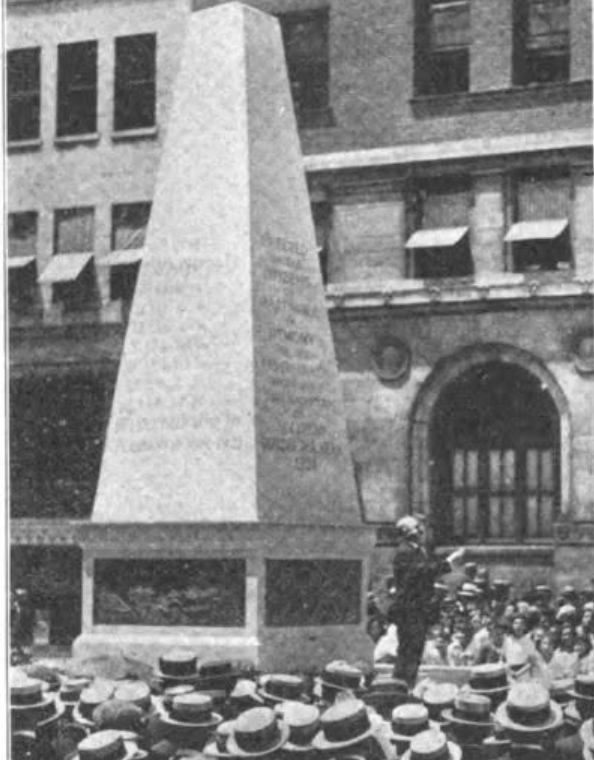
In June 1922, Baltimore put up a 25-foot obelisk in Courthouse Plaza inscribed to the 130 children killed by drivers in the city the year before. Cities across the country were doing versions of this. The dead were overwhelmingly pedestrians and overwhelmingly young, and people had not yet grown accustomed to this fatal risk in their communities.
Cincinnati tried to do something about it. A citizens’ committee spent 1922 gathering signatures to put an ordinance on the ballot requiring every automobile operating inside the city to carry a mechanical governor physically limiting it to 25 miles per hour. Car dealers and the auto clubs organized against it. The measure lost 92,427 to 14,012 (87%-13%). Cincinnati recorded 103 traffic deaths the year of the vote, 157 by 1929, and 201 by 1934.
Connecticut took a different route in 1925, requiring drivers to prove after a crash that they could pay for the damages they had caused. Massachusetts went further in 1927, requiring proof of insurance as a prerequisite to registration. The required minimum coverage was $5,000 for the death or injury of one person, and $10,000 for everyone hurt in a single crash. Unlike a speed governor that restricts how a car gets driven, a financial responsibility law does little to prevent the crash itself.
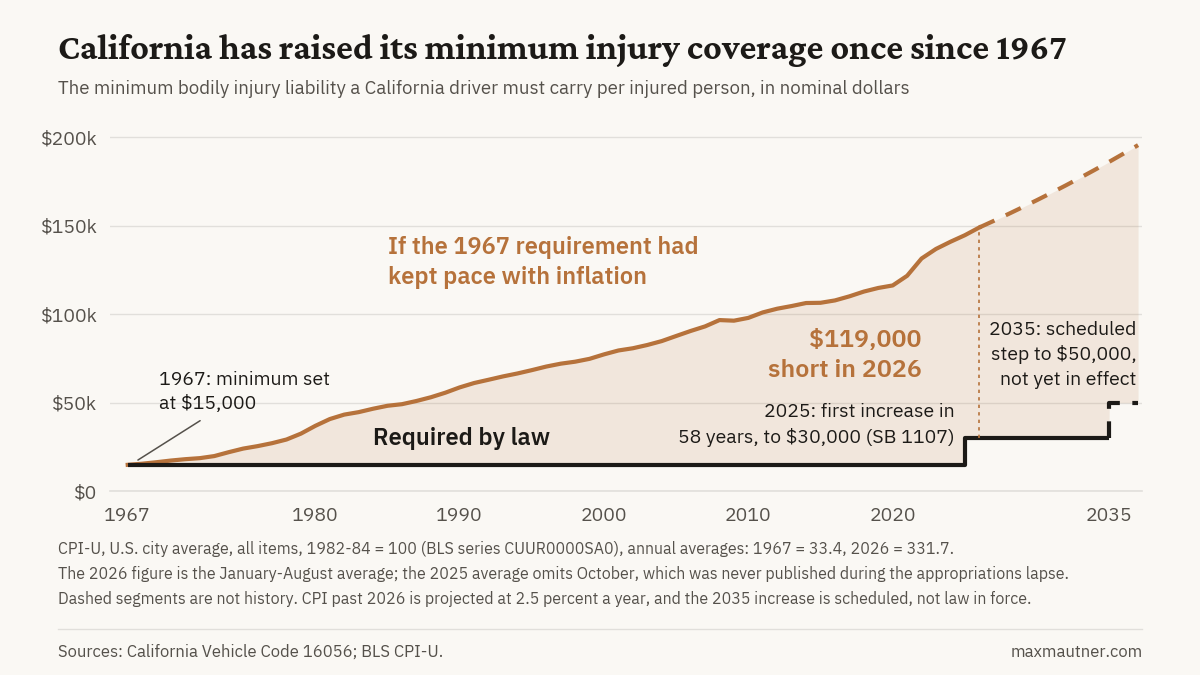
Yet that is the version of driver safety policy that stuck. Every state except New Hampshire now requires some form of car insurance in order to drive, and it is the oldest surviving answer that American law gave to the automobile’s collateral damage. It has also been allowed to rot: the $5,000 that Massachusetts required in 1927 would be ~$96,000 in today’s money. Massachusetts requires $25,000 today, raised from $20,000 in July 2025 after ~40 years at the lower figure.
California set its minimum at $15,000 per person and $30,000 per crash in 1967. That $15,000 is worth ~$150,000 now, but it remained unchanged for 58 years. Senate Bill 1107, effective January 1, 2025, raised it to $30,000 per person, and writes in a further increase to $50,000 on January 1, 2035. While ~2.5 million people died on American roads between 1967 and 2024, California did not touch the number once. The increase that finally arrived (celebrated as the first in more than half a century) landed at 1/5th of the 1967 inflation-adjusted value.
NHTSA tracks what a road death costs in The Economic and Societal Impact of Motor Vehicle Crashes: the average traffic fatality carries $1.6 million in discounted lifetime economic cost in 2019 dollars, ~$2 million today. That figure is lost market and household productivity, medical care, emergency services, legal and court costs, and property damage. Crashes in total cost $340 billion in 2019, 1.6% of GDP.
The same NHTSA report tracks who pays it. People not directly involved in the crash cover roughly 3/4 of all crash costs, $261 billion in 2019, through their own insurance premiums, their taxes, and congestion. Public revenues alone cover ~9%, $30 billion, which NHTSA converts to $230 in added taxes per American household per year. Every household in the country is paying an annual bill for crashes it had nothing to do with.
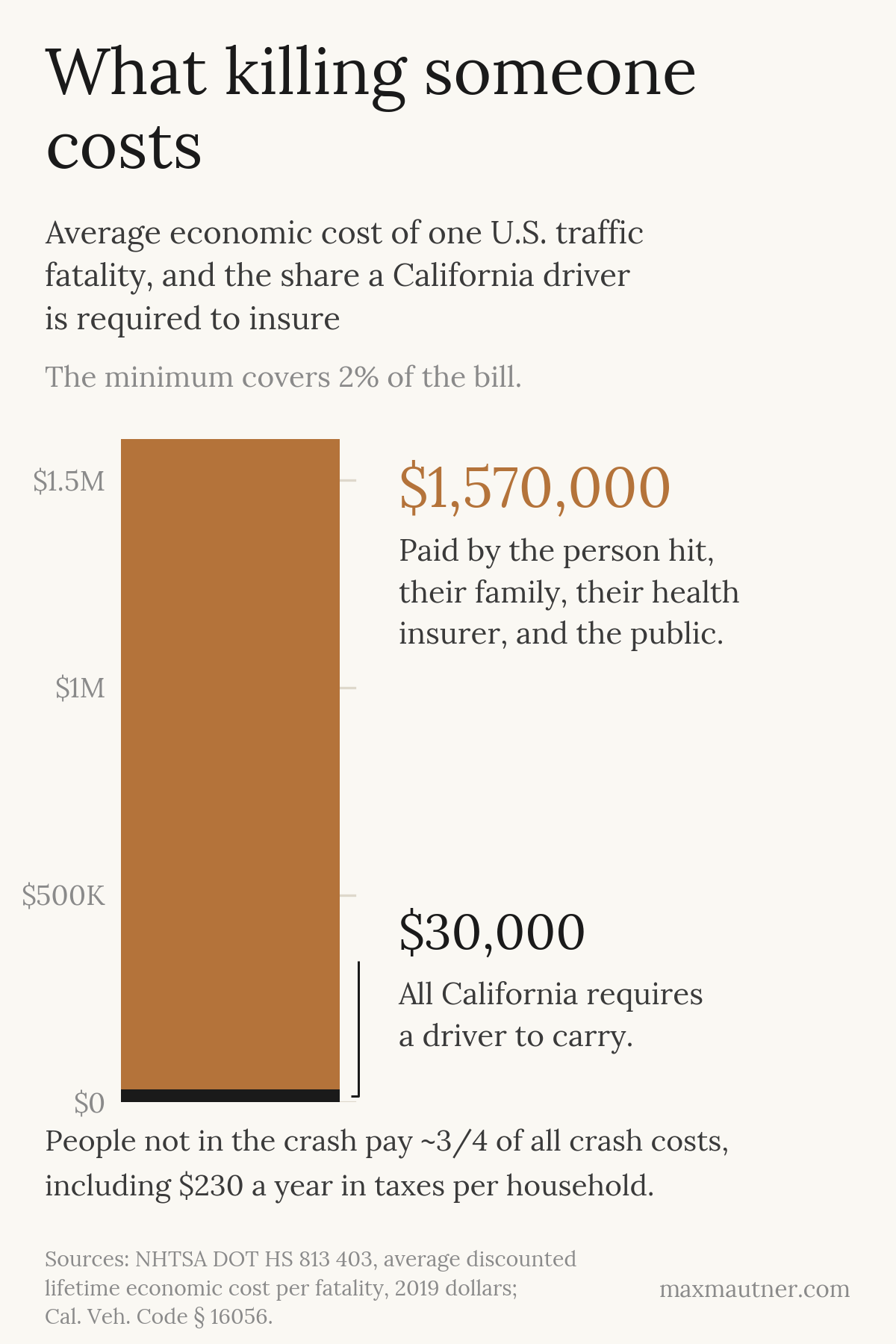
The gap does not get collected later. A driver who kills someone owes the whole judgment, and the policy limit binds only the insurer, but past the policy limit there is usually nothing left to take. Home equity, retirement accounts, and wages are either untouchable or capped by state exemption law. An ordinary negligent driving judgment then discharges in bankruptcy, with a carve-out at 11 U.S.C. §523(a)(9) for death or injury caused by drunk driving. In practice the insurer pays $30,000, the lawyer runs an asset check, and the case ends. A person can take a life, settle for 2% of the economic damage, keep the house, and walk.
It gets worse below the minimum: the Insurance Research Council put 15.4% of US drivers uninsured in 2023 and another 18% underinsured, 33.4% combined. One in three US drivers cannot pay for the harm they are statistically likely to do. What they cannot pay lands on the victim’s own uninsured motorist coverage, which is sold only as part of an auto policy. A pedestrian or cyclist who does not own a car cannot buy it at any price, and is left with health insurance, which pays for the hospital and nothing else. Even the ambulance ride from the crash site is an out-of-network charge 51% of the time.
The reason the number stays low is that once the state requires buying insurance, the minimum it picks determines two things:
- who can afford to drive at all
- how many drivers carry insurance, since some share of drivers priced out of a policy keep driving uninsured and unregistered instead
So the floor gets set by affordability politics rather than by the size of the bill, and once set it is left alone, because raising it means raising insurance prices.
California’s 2035 minimum coverage hike has already been priced. Quadrant Information Services rate filings, published by CarInsurance.com in March 2026, put a California liability-only policy at today’s minimum at $1,019 a year, and the same policy raised to $50,000 per injured person at $1,120. The higher quote also carries more property damage coverage than California requires, so it prices the generous version of the change. The difference is $101 a year. Going from $30,000 to $50,000 per person is the increase the Legislature already voted for and scheduled 10 years out, and it costs ~$8 a month to all (insured) California drivers.
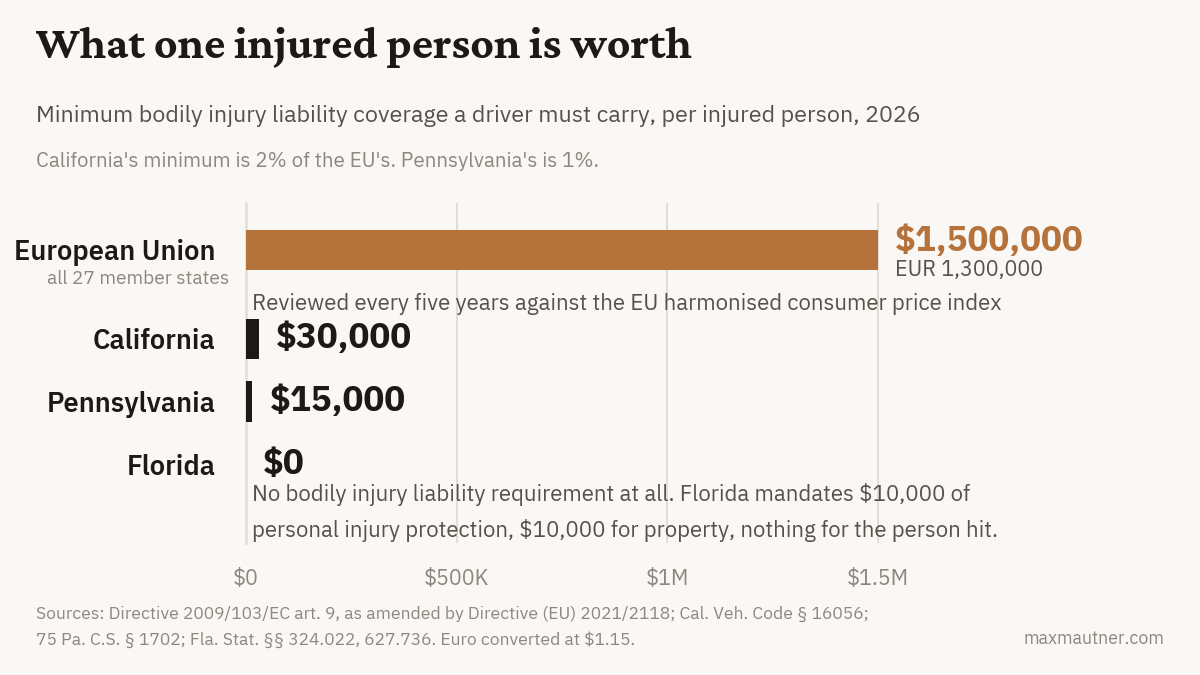
Europe treats the same question as settled. The EU motor insurance directive requires every member state to mandate at least €1,300,000 of coverage per injured person, ~$1.5 million, or €6,450,000 per crash regardless of how many people were hurt, ~$7.4 million, revised every 5 years against the European consumer price index automatically. The United Kingdom requires unlimited coverage for personal injury. California requires 2% of the European per-person floor, Pennsylvania 1%, and Florida nothing at all.
California came close to fixing the drift. SB 1107 as introduced in 2022 would have raised the limits 4% every 5 years starting in 2028. That clause did not survive negotiations with the Personal Insurance Federation of California. What passed was a fixed step-up to $50,000 in 2035, which guarantees the same erosion starts again the day it takes effect.
The strongest technical objection to inflation-indexing is expiring. Until recently an insurer could not observe how riskily any given driver actually drove, so a higher mandate raised every California premium without sorting dangerous drivers from safe ones. In-car dongles that track jerky driving, crash event recorders, and driver monitoring systems now let an insurer observe behavior directly and price it.

What actually gets priced by insurers is the open question. An insurer will use new per-person driving data to reduce its own losses, and nothing in the current arrangement makes them price the risk that a heavy, fast vehicle poses to people outside it, because the loss the insurer faces is capped at a figure the Legislature picked. Any member of the California Legislature can introduce a bill to tie the mandatory coverage minimum to inflation before 2035. If they fail to do so then it restarts the same 58-year slide over again, and the households paying $230 a year for other people’s crashes keep paying it.
Enjoyed this post? Get new posts via email