Essay · HOUSING
1 in 4 new California homes is in someone's backyard

In 2025, California cities permitted 41,846 accessory dwelling units and 43,083 detached houses, according to their annual reports to the state. ADUs were a quarter of all new homes permitted. In 2016 cities permitted only 1,336 of them.
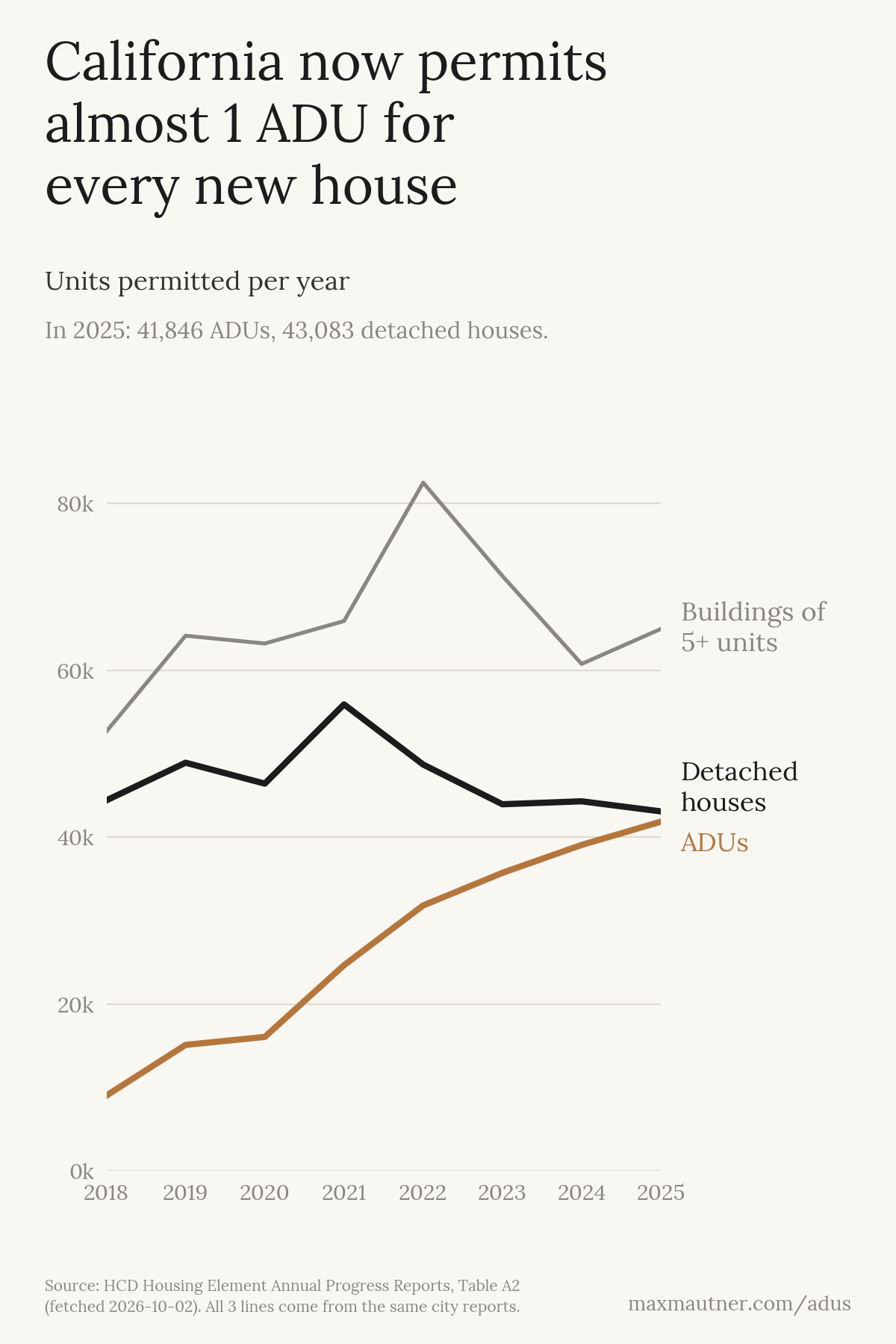
That growth followed the state taking away cities’ power to say no, known as “state preemption.” A city now has to approve or deny an ADU application within 60 days, without a hearing, judged only against objective standards. Permits run ahead of finished homes: from 2018 through 2025 cities reported ~213,000 ADU permits and ~108,000 completed ADUs, and some permits legalize garages people already lived in.
ADUs took off because the person who decides to build one is the person who gets paid for it. A homeowner needs no developer and no subdivision. When my wife and I were pricing an ADU, our contractor gave us a reference: a senior couple who had built one, rented it to a great tenant at a very good rent without any trouble, and used the income to de-risk their retirement.
SB 9, the 2021 law that lets owners split a lot or build a duplex, is much more complicated than an ADU project. In its first year, Los Angeles received 211 applications for SB 9 units and approved 38. In contrast, the city permitted 7,160 ADUs that year.
We looked at an ADU when we had a baby, and built an addition instead. The bids came in within ~$10,000 of each other. Trenching utilities out to a separate building carried more cost and risk than tying an addition into the house, and our setbacks ruled out the prefab unit we wanted. We never planned to rent it out. We wanted room for visiting family and space to work and care for the baby, and on our lot an addition was the better way to get it. The city approved our permit in ~6 weeks, so permitting had nothing to do with the choice.
It took ~26 bills over 10 years to get here, by my count of HCD’s handbook, because cities kept finding workarounds. Some required the owner to live on the property, some wrote design rules a planner could read however he liked, and some charged impact fees. The state banned the first 2 outright and barred impact fees on ADUs of 750 square feet or less. In 2023 Huntington Beach stopped processing ADU applications altogether. The Attorney General sued, and the council backed down ~2 weeks later. Since 2025, a city that doesn’t submit its ADU ordinance to the state, or doesn’t answer the state’s objections to it, loses the ordinance and has to permit under state rules.
Many of those ADUs replaced garages, and state law bars cities from making owners replace the parking. In a survey of owners who built ADUs in 2018 and 2019, 23% were garage or other accessory-structure conversions. Those garages mostly held storage: a study in Sacramento found more than 75% of households had enough off-street parking for all their cars after accounting for how they actually used their garages. Nobody has measured the net change in off-street parking. My family would not have built anything, ADU or addition, if the city had required a new parking space.
ADUs are a brilliant end-run on local prohibitions on infill housing development. We will see how far YIMBYs can push the envelope on state preemption, but so far it is an astounding success.
The charts are generated by this code, which lists every input and its source.
Enjoyed this post? Get new posts via email