Essay · TRANSIT
Closing Streets to Cars Helps Business. It Works in Small Towns Too

My last post made the case that closing streets to cars is good for business.
The examples I used were New York City and Montreal—-both well-documented pedestrian successes, but also enormous corridors that make it hard to make a persuasive case that their learnings could be applied in any city smaller than a New York or Montreal.
This post is for the smaller places.
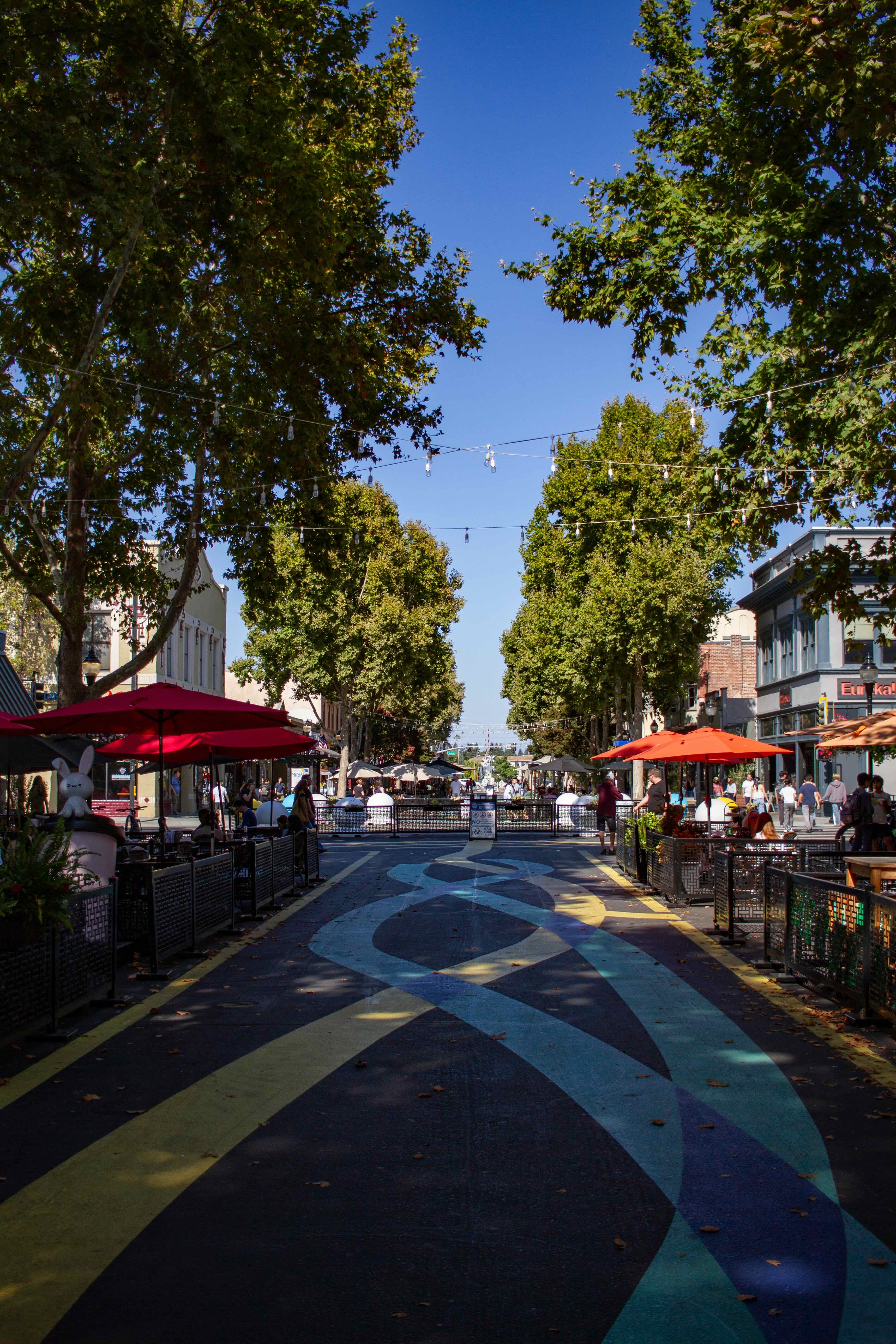
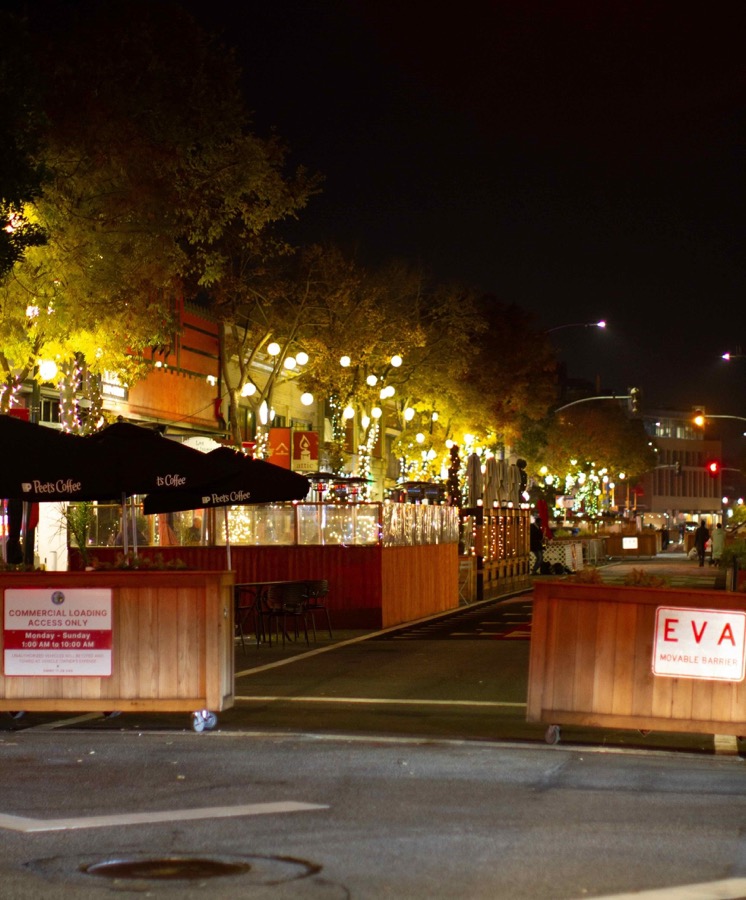 B Street in downtown San Mateo, CA. The lights are nice. On most nights, it’s quiet.
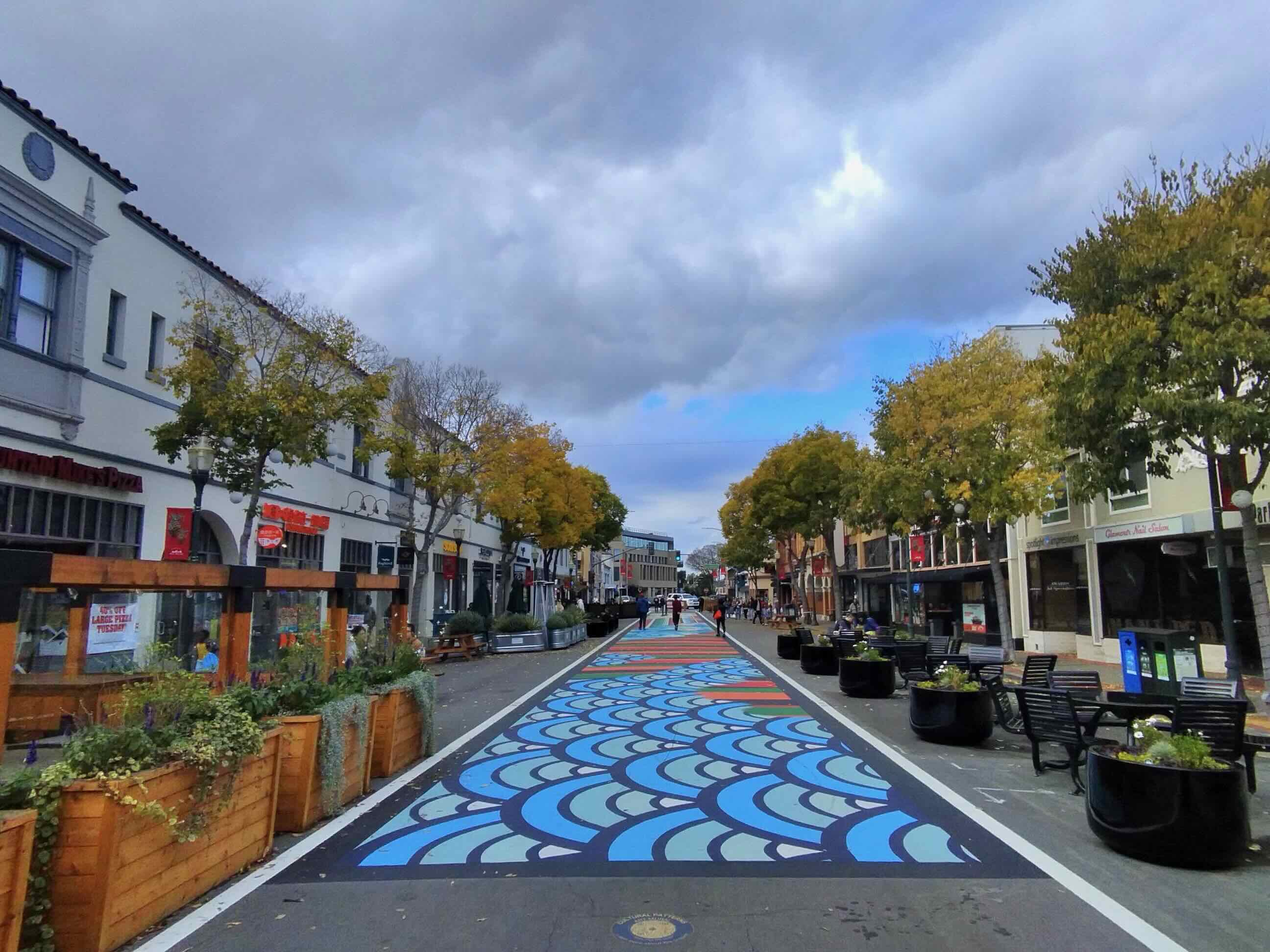 B Street on a slow afternoon. The mural is there. The planters are there. The benches are there. The people aren’t. A closed street without a reason to visit it is just an empty street.
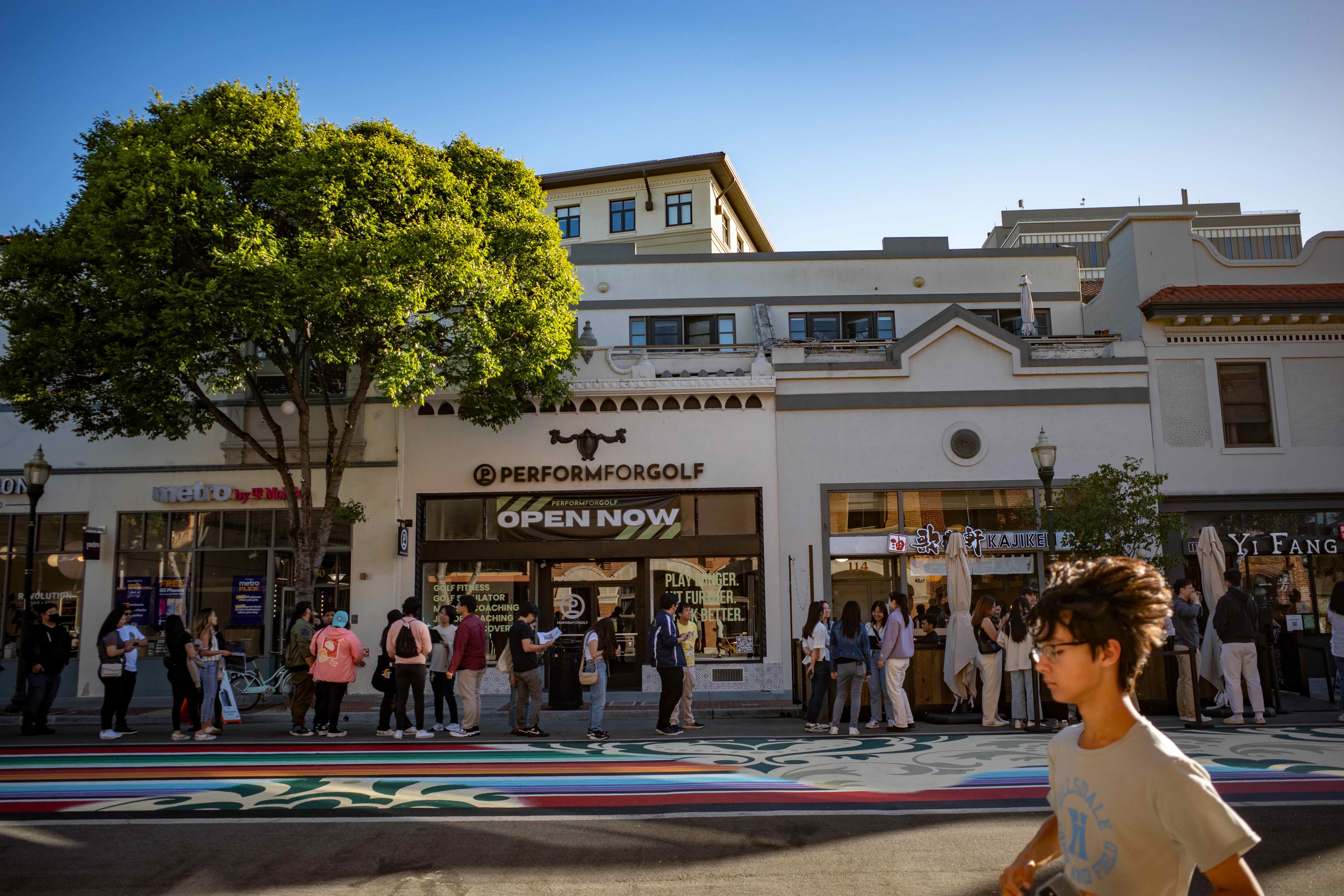 Also B Street. Same street, different night. Kajiken opened on the pedestrianized street and regularly has lines out the door to this day.
Closing the street is step one–but not the whole plan.
The Effect Isn’t About Scale
A 2022 study across 14 Spanish cities found that pedestrianized streets outperformed car-dominated ones in retail sales.
It also found that geographic location was insignificant. If anything, smaller cities saw a larger effect.
Mid-sized towns had the same outcome as major metros.
The mechanism is the same everywhere:
(make a street feel less hostile) + (slow people down) = (people spend money)
Philadelphia’s Center City District launched “Open Streets” in September 2024.
They closed blocks of Walnut and 18th streets on Sundays.
After 21 events and one full year foot traffic was up 65%, sales were up 39%.
In Hamburg, New York (population ~10,000) the village fought a highway-widening proposal and got traffic calming roundabouts instead.
You don’t need Times Square foot traffic for this to work, you just need a street where people feel comfortable slowing down.
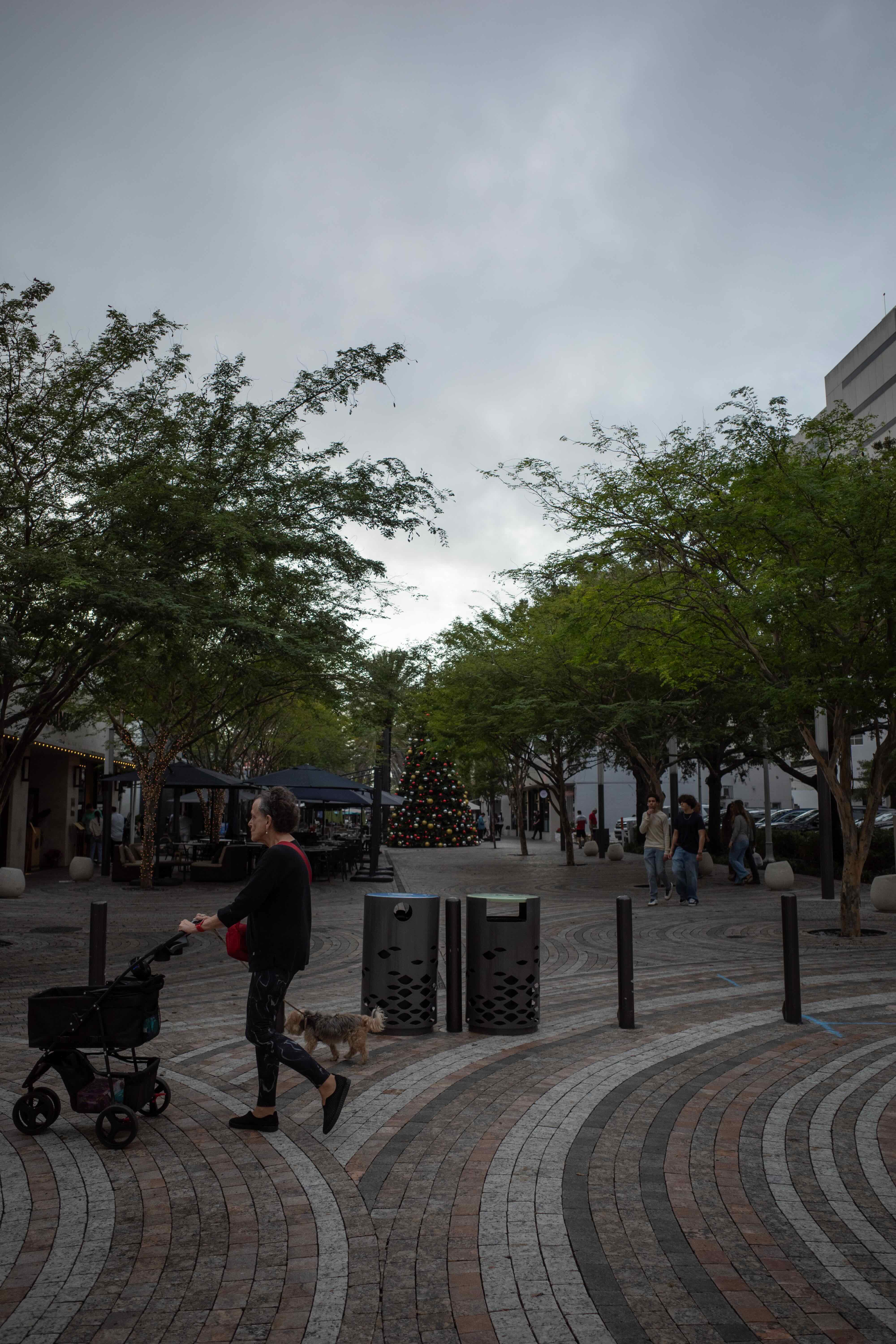
Giralda Avenue in Coral Gables, Florida (top) and Castro Street in Mountain View, California (bottom). Both suburban, both permanent, both are not Times Square.
The Ladder
Most small downtowns are already doing temporary pedestrianization without calling it that:
- A farmers market that closes a block on Saturday mornings
- A holiday street fair
- Restaurant week with tables in a parking lane
These are all the same thing. The only difference is nobody’s measuring whether the coffee shop two doors down did more business that morning.
And nobody’s using that data to make a case for doing it more often!
Here is a ladder of steps to pedestrianize a street–from minimal to maximal effort:
Beginner: One-off event
A street fair, a block party, a holiday closure.
Before you do it count foot traffic on a normal version of that day. Afterwards, survey the merchants.
This data is the key to everything.
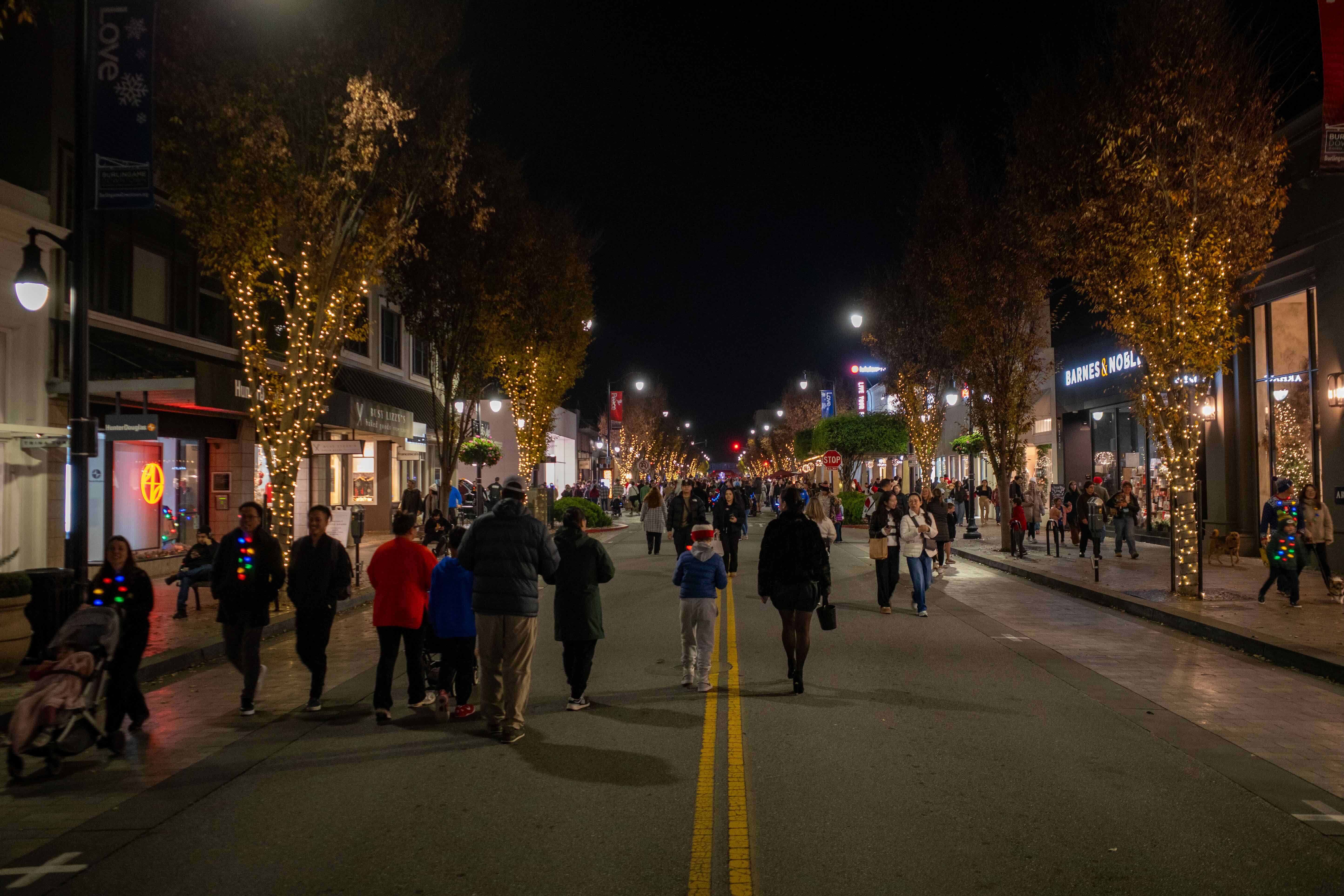
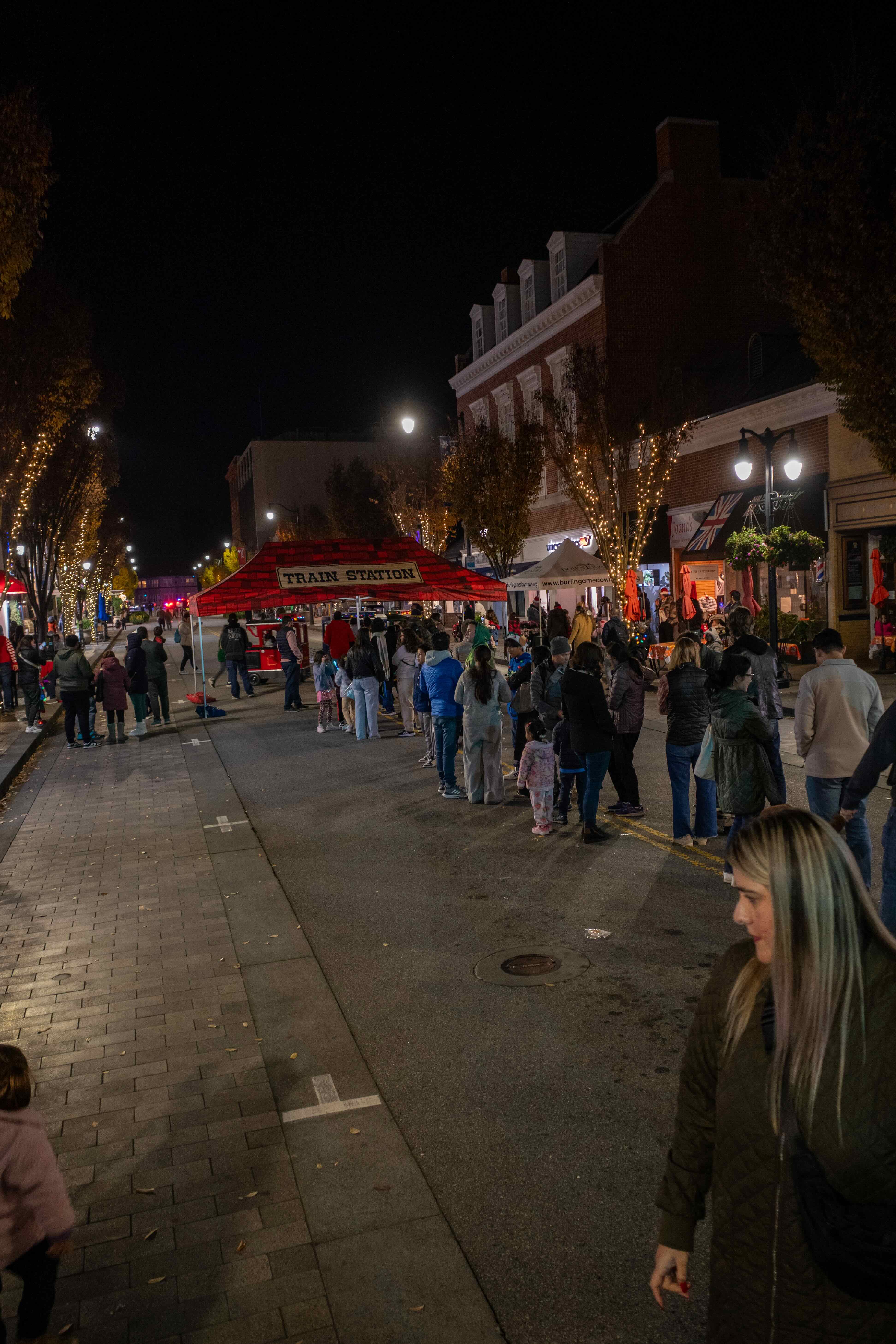 Burlingame Avenue, Burlingame, CA closed for the holidays.
The infrastructure required to close a residential block for a day is basically nothing.
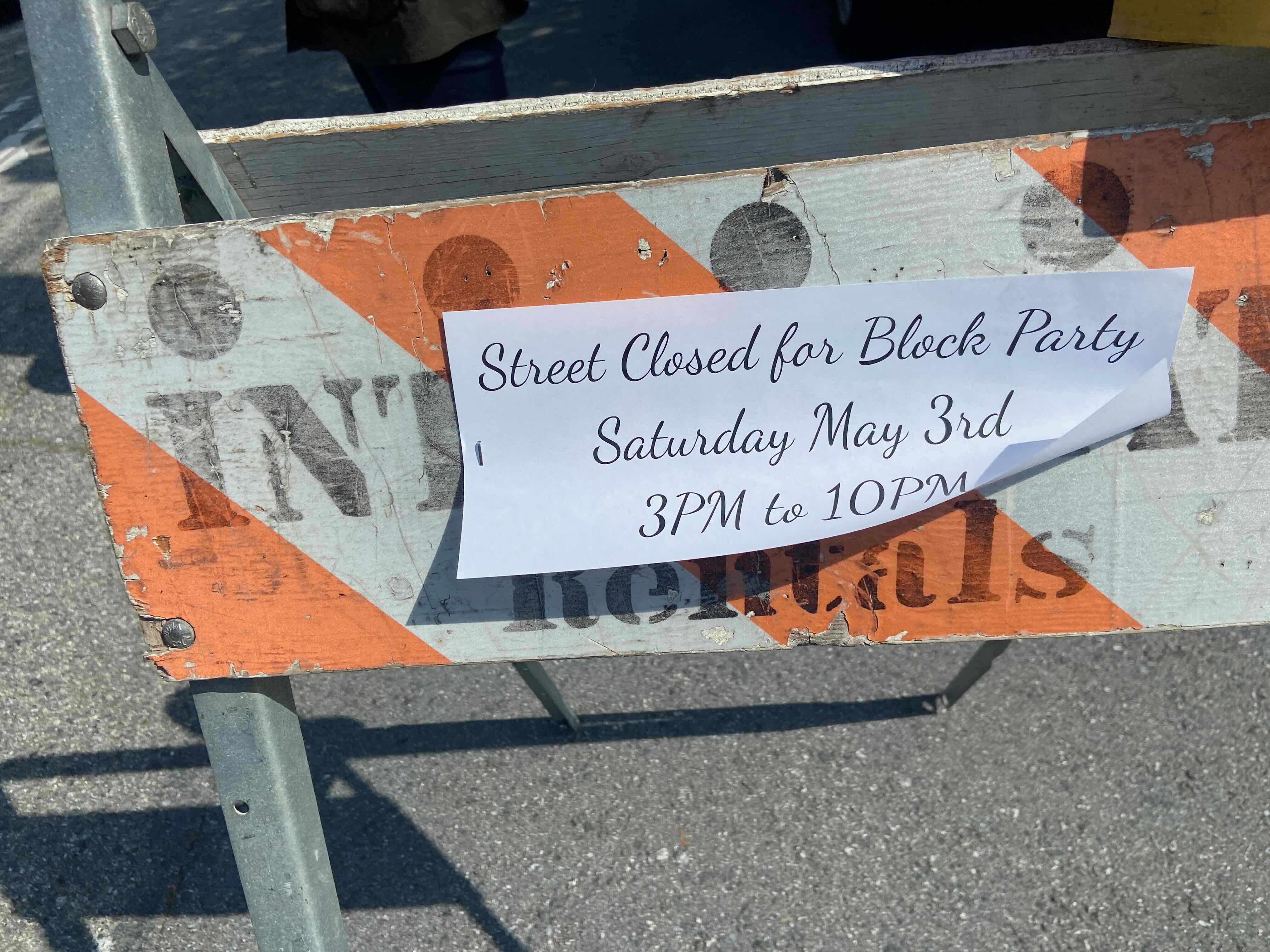 The physical infrastructure for closing a street to throw a block party. The harder part is collecting enough neighbor signatures to get the city permit.
On a commercial street, that bureaucratic hurdle largely disappears
A business improvement district (BID) or city department can handle the paperwork without needing signatures from every adjacent merchant.
The harder part is political will and not logistics.
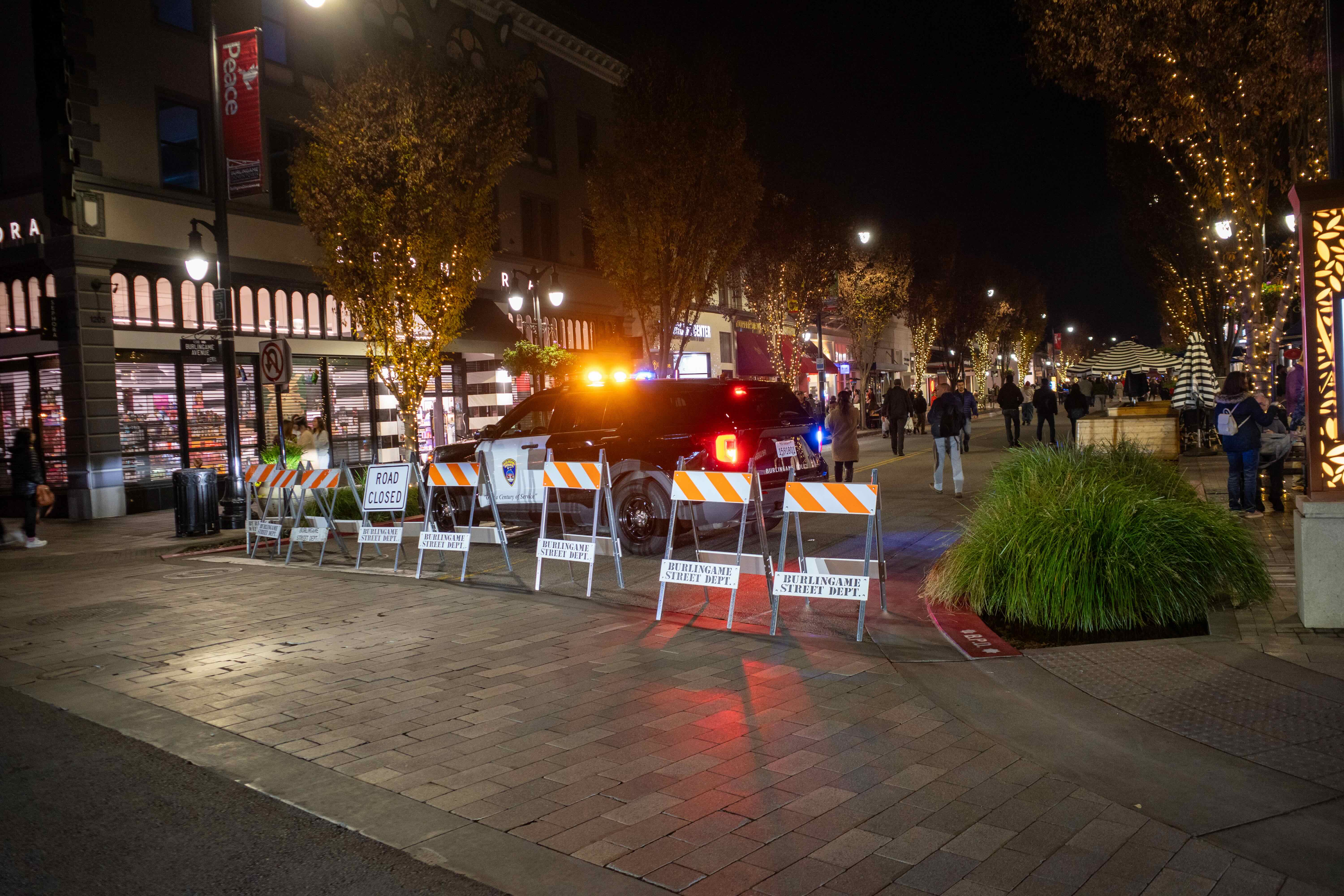 The entire closure scheme for Burlingame Avenue. A police car and some sawhorses.
Medium: Weekly recurring
This could be a farmers market on the same block, every week.
People who came for the fresh produce walk past the coffee shop and the bookstore.
Start checking whether adjacent non-market businesses see a bump on market mornings, as they usually do.
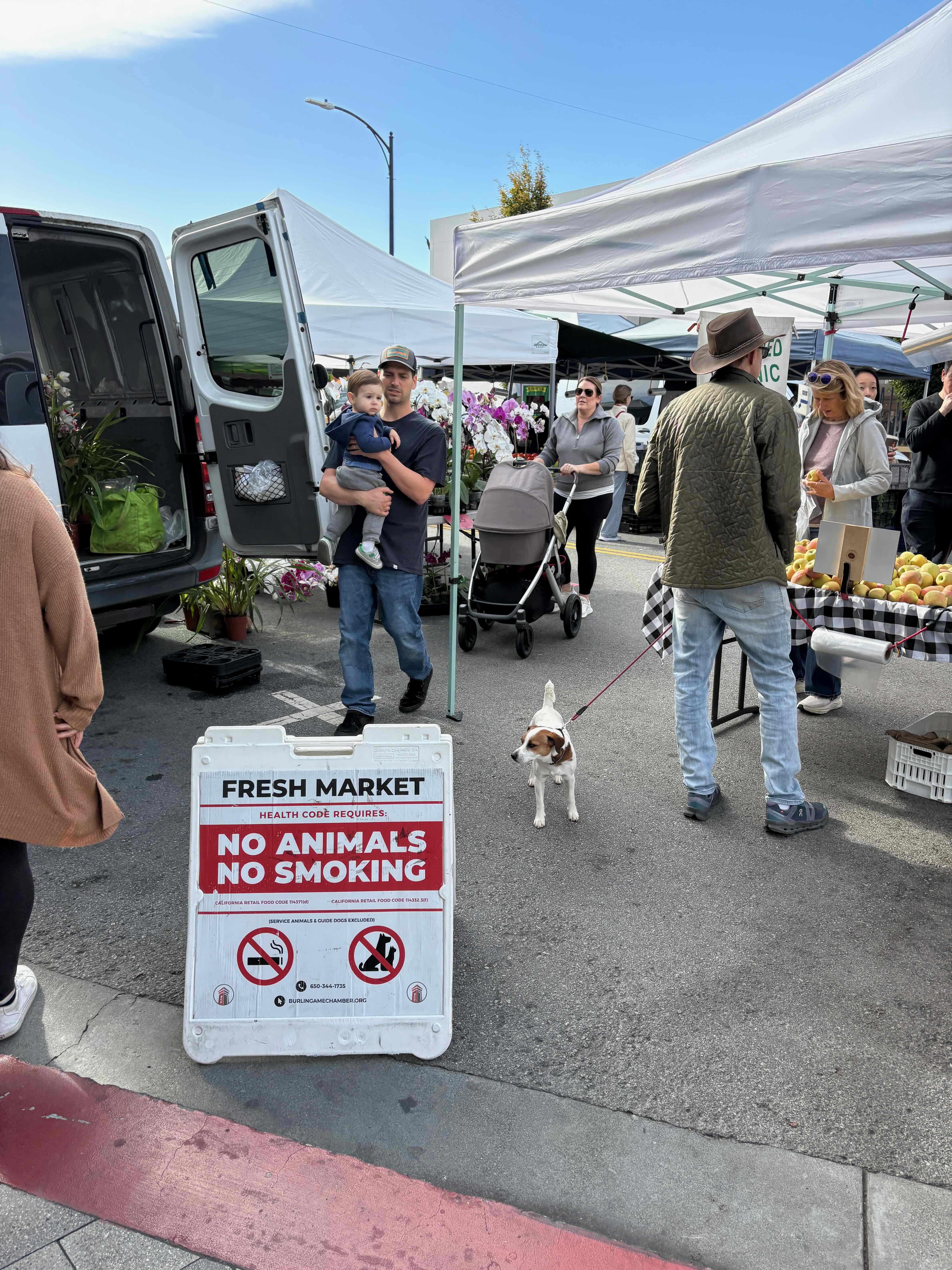 The Burlingame Farmers Market on Park Road. The sign says no animals, the dog does not care!
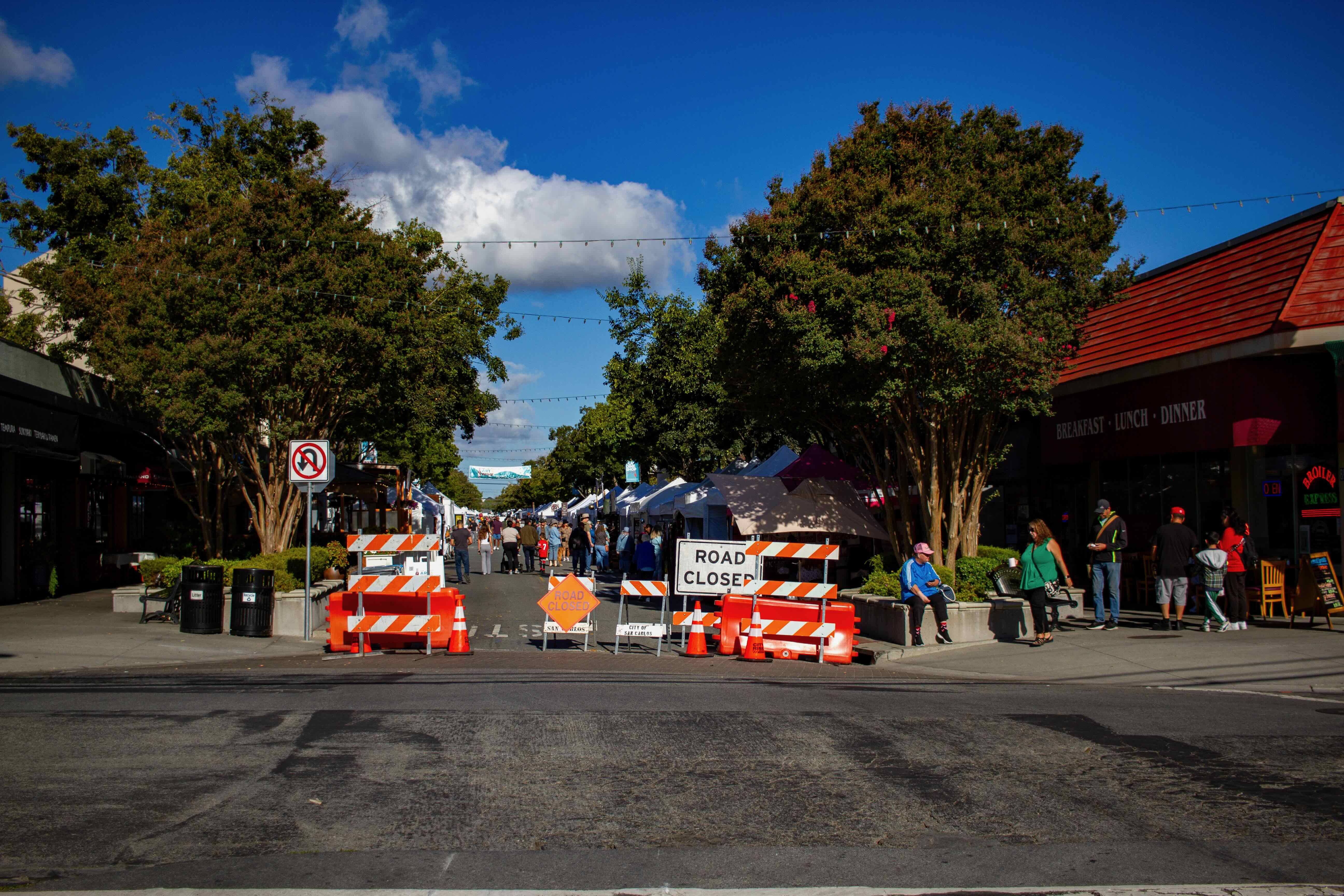 San Carlos, CA closes Laurel Street the same way Burlingame closes Burlingame Avenue: cones and a sign.
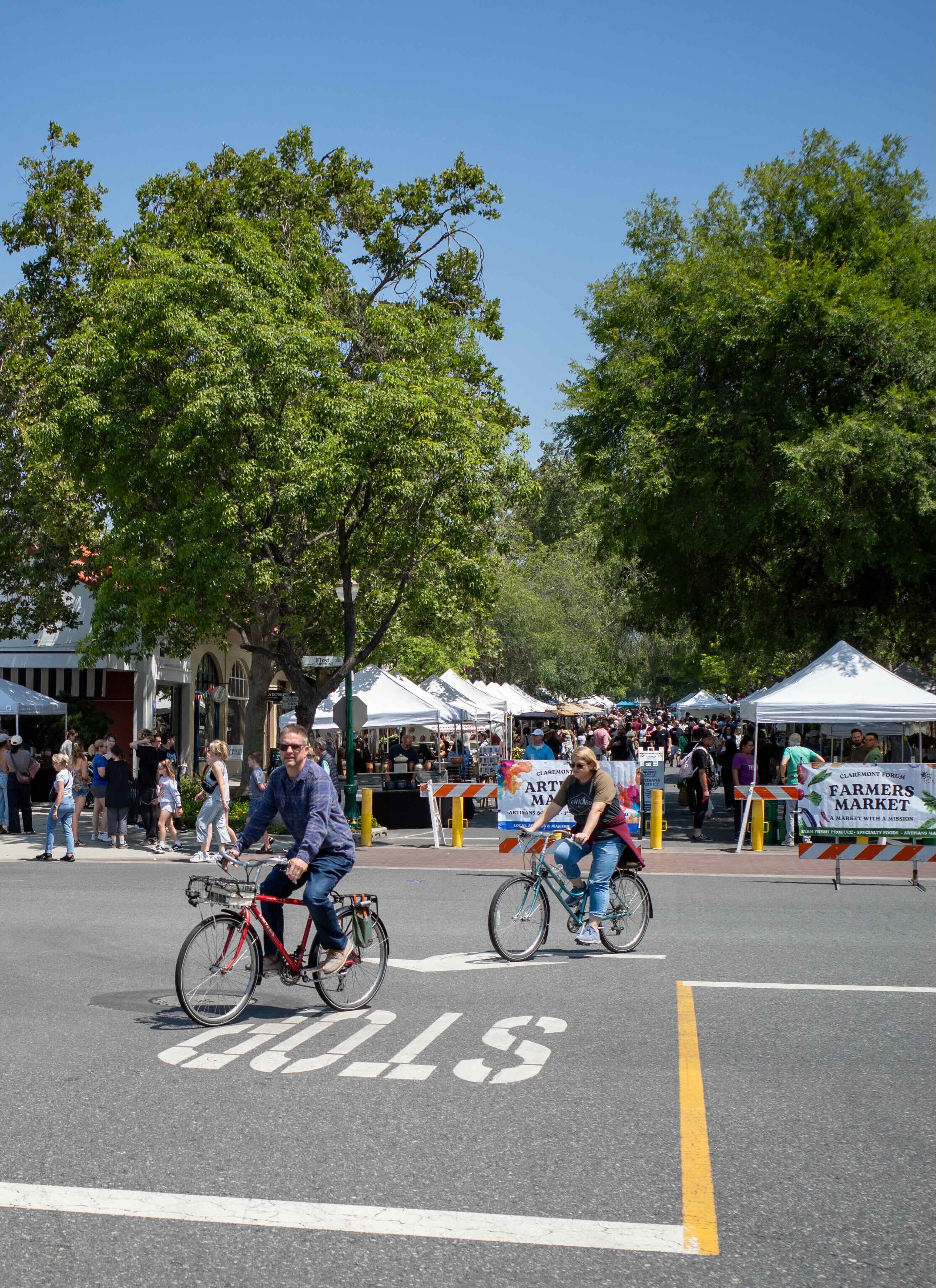
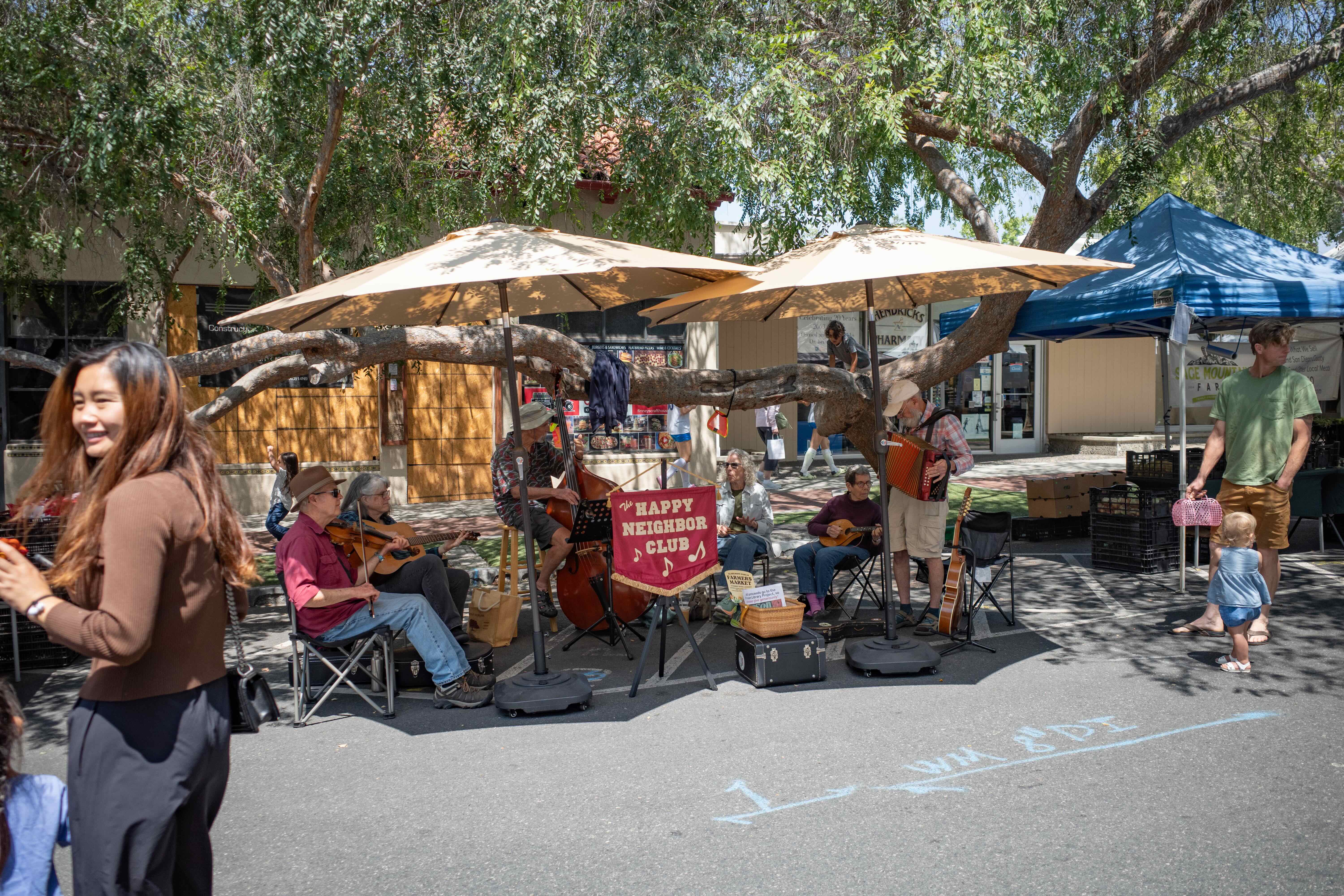
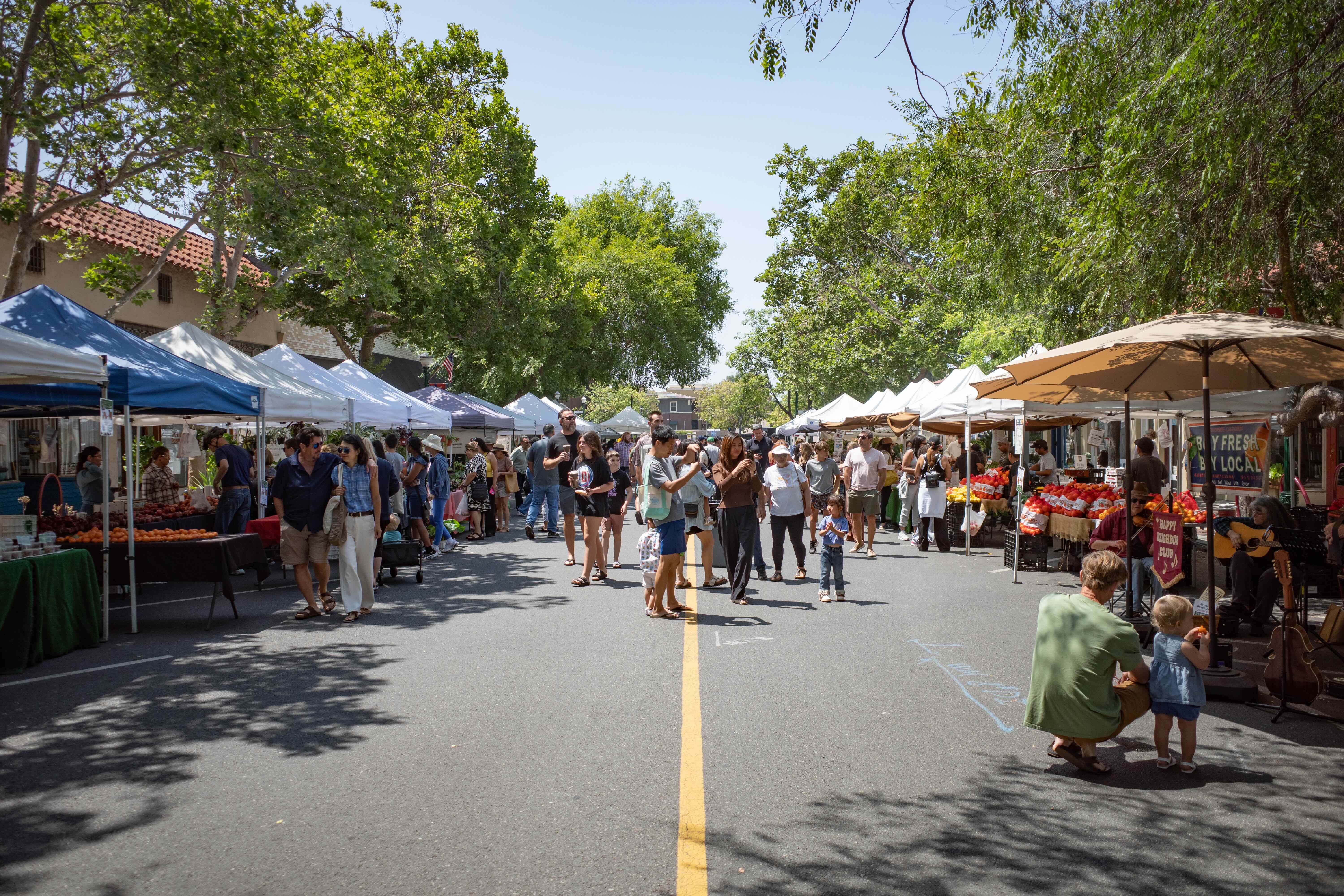 The Claremont, CA farmers market. Music, families, cyclists. There’s a reason to be here beyond groceries.
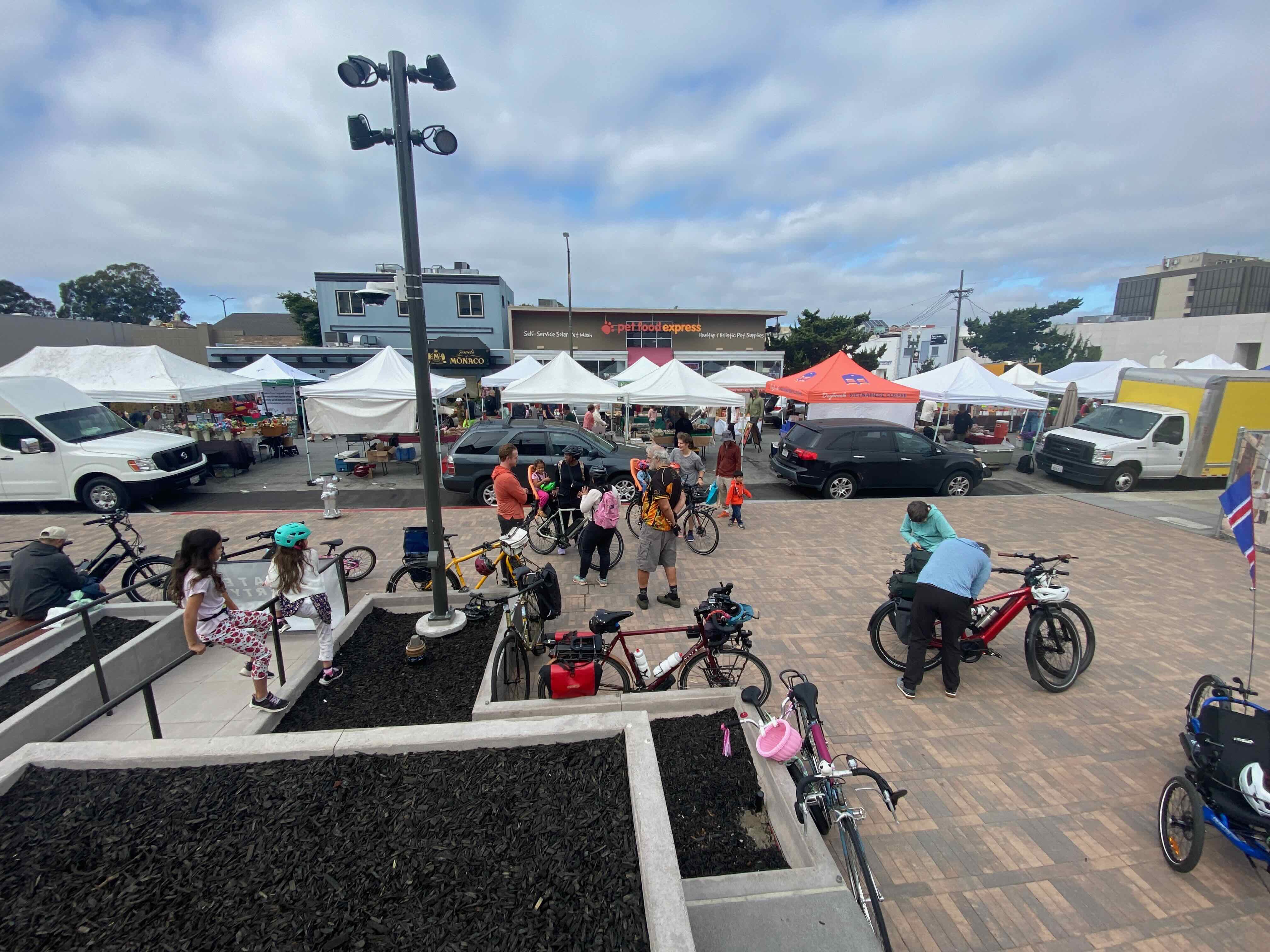
I organized a group bike ride from downtown San Mateo to Burlingame’s Sunday farmers market.
I did it partly to show a safe route between the two downtowns, partly to celebrate Burlingame for closing the street for it.
Harder: Seasonal open streets
Close a block every Sunday afternoon from May through September. Some chairs, maybe a musician, minimal infrastructure. Philadelphia has been doing this since late 2024 — 21 events, 65% increase in foot traffic, 39% bump in sales.
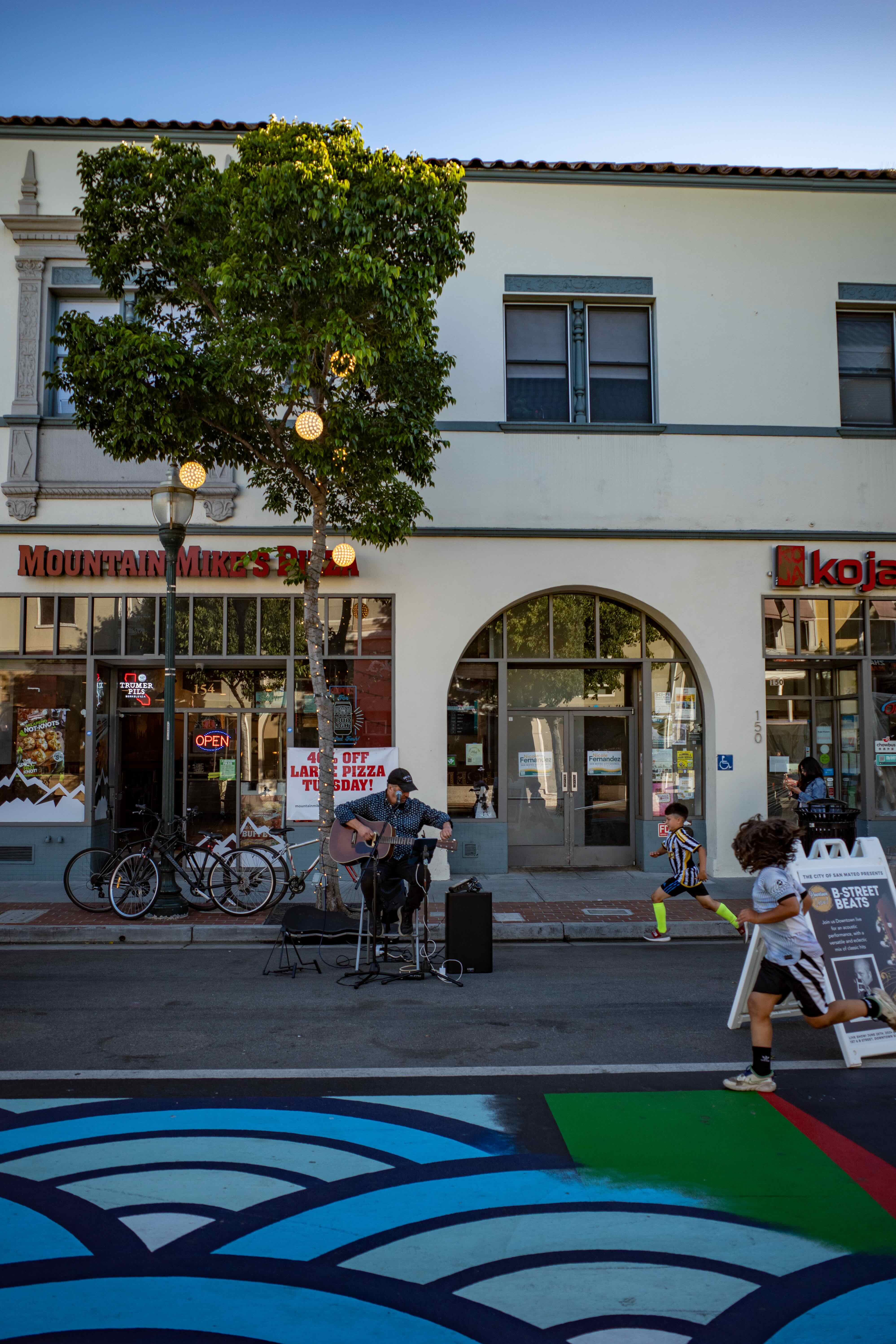 B Street Beats — a city-organized music series on the pedestrianized blocks. Two kids running toward a guitarist is a decent sign the street is working.
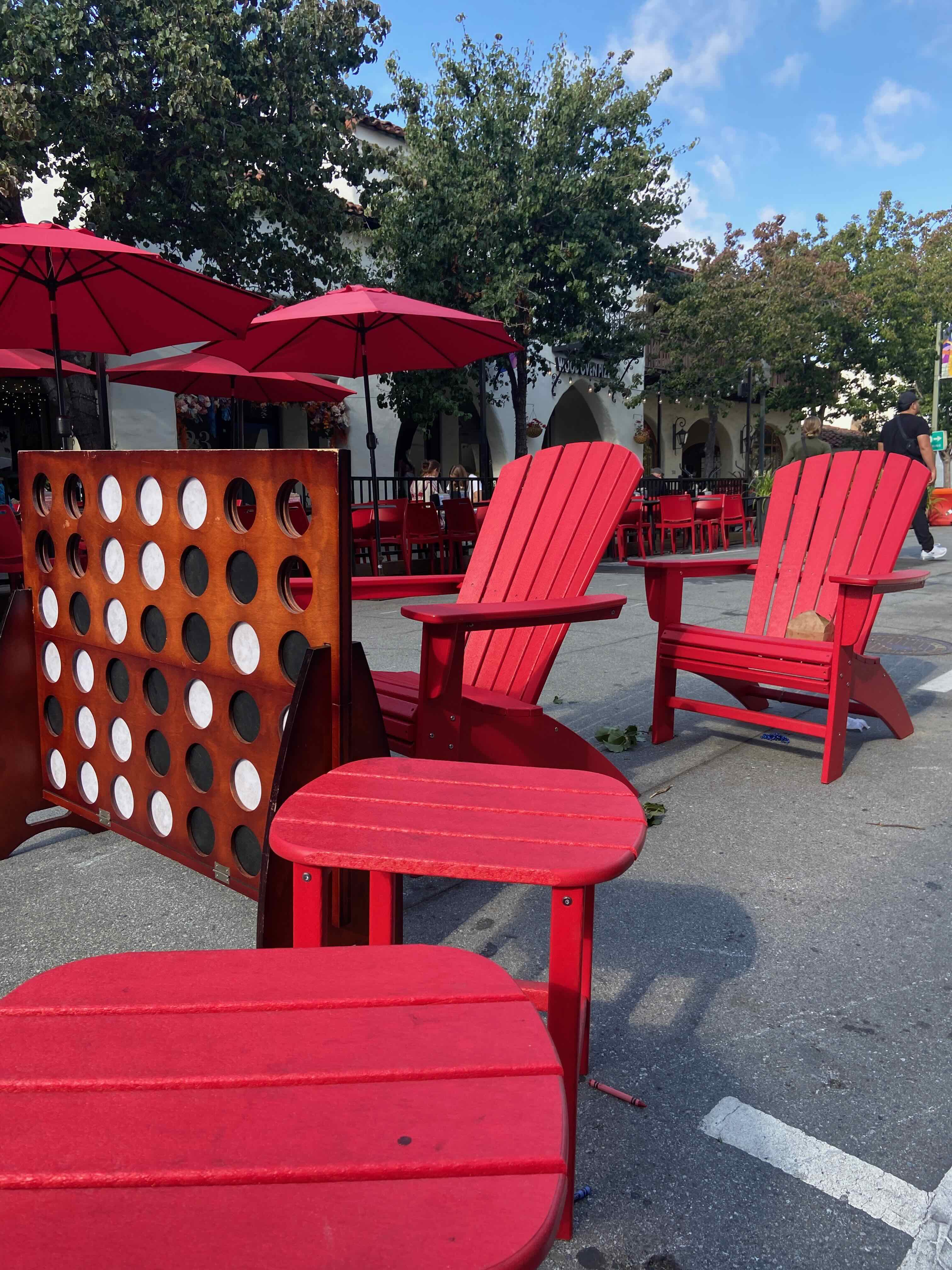 Red Adirondack chairs and a jumbo Connect 4 on a closed street in Palo Alto, CA. Expensive-looking furniture, left out in public. Somehow it doesn’t walk away.
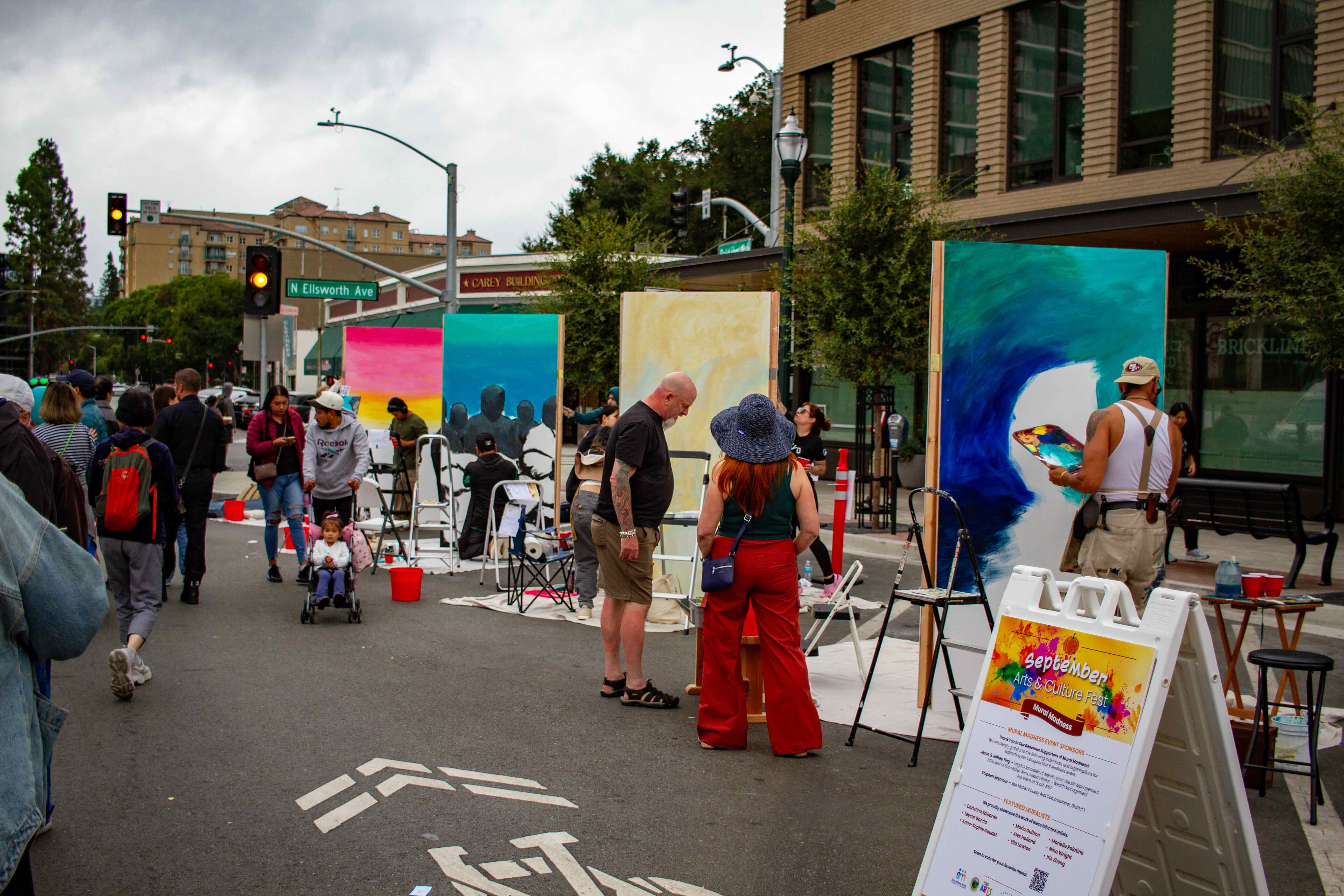
Programming is the thing most cities skip. A closure without programming is just an empty street with the cars removed. A closure with a musician, a game, a reason to sit down — that’s a destination.
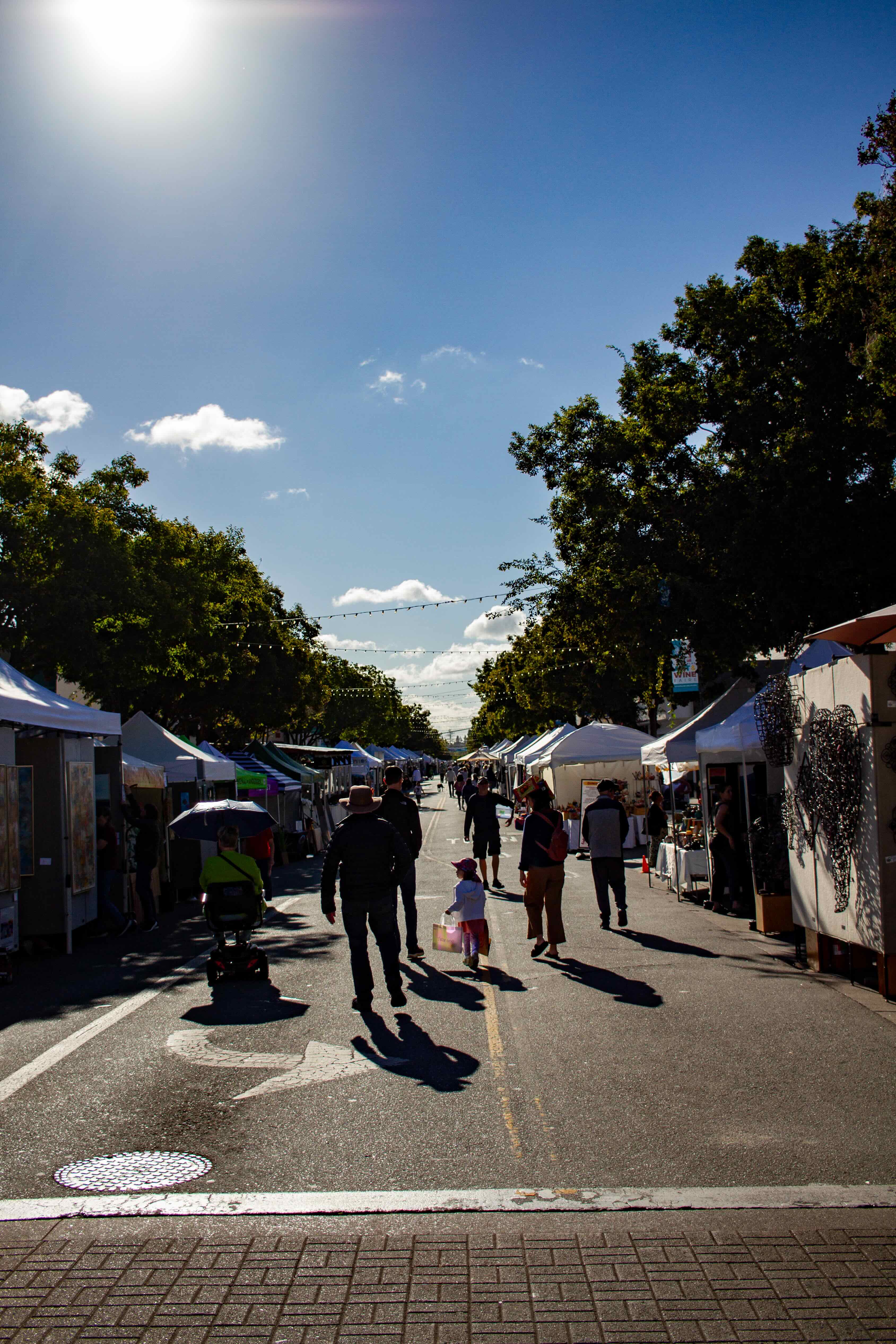 A craft festival on Laurel Street in San Carlos. Stalls on both sides, people in the middle, reason to be there.
Expert: Six-month pilot.
Bollards, outdoor seating, delivery access until 10am, data collection, merchant partnership, a decision point at the end with actual numbers.
This is what I described in the last post.
Cities find their own version of the same infrastructure:
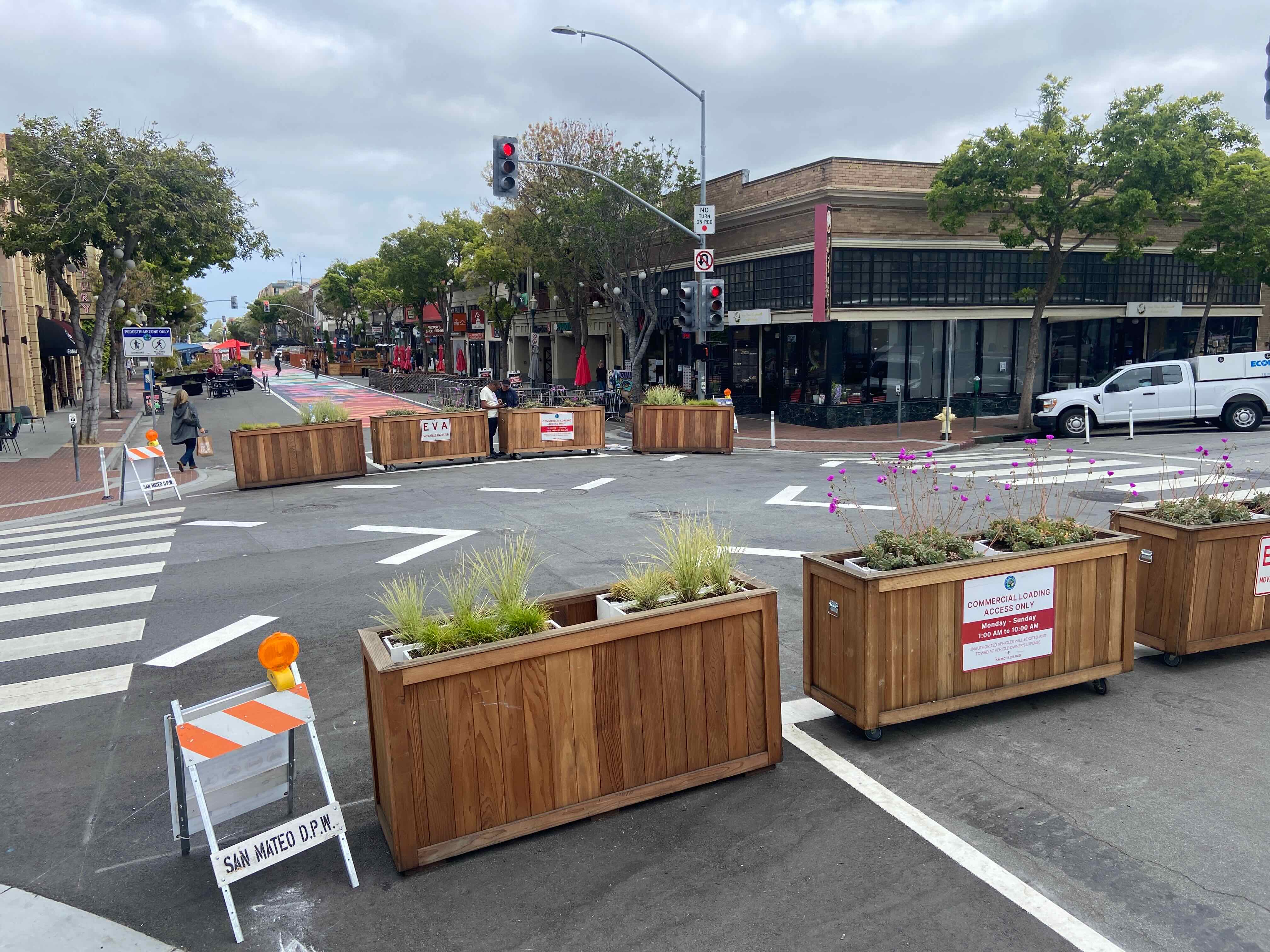 San Mateo, CA uses wooden planters on wheels as movable barriers for B Street. They’re cheaper than bollards, easier to move for deliveries, and avoid the risk of hitting aged undocumented utilities if you dig. The sign on the front says commercial loading is permitted from 1am to 10am.
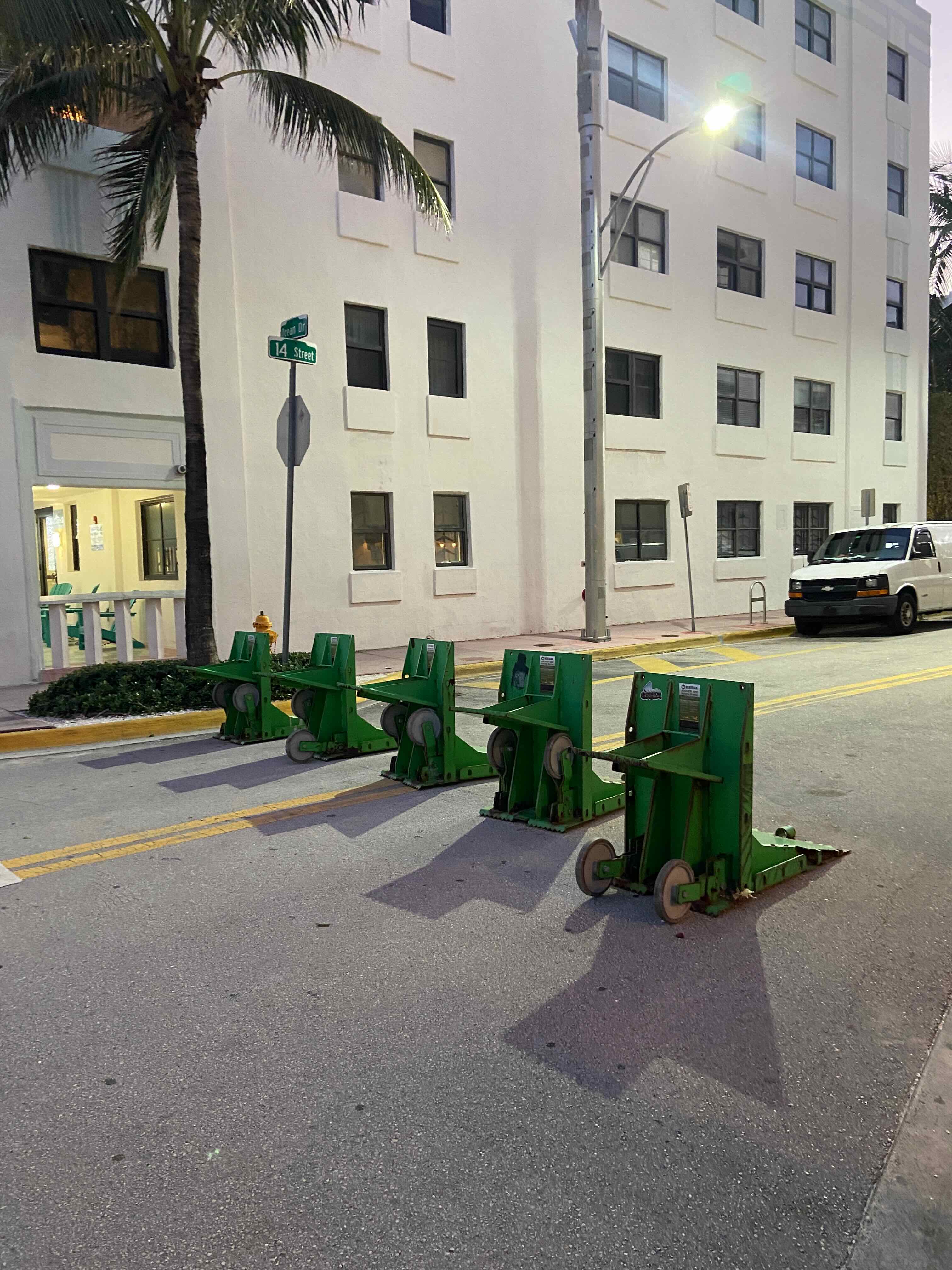 Miami Beach, FL uses green plastic jersey barriers on Ocean Drive.
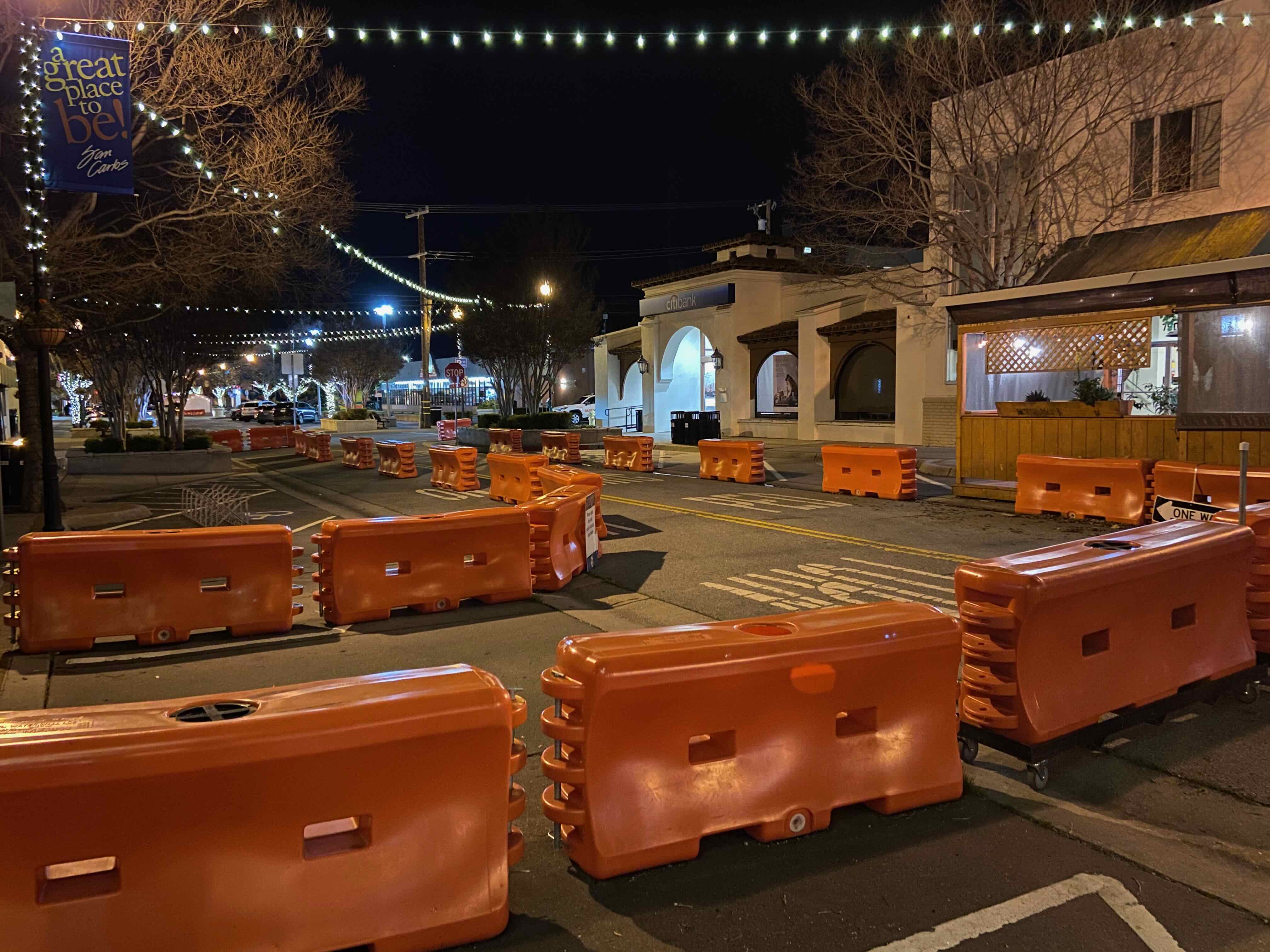 San Carlos’s early attempt at closing Laurel Street. Not aesthetic. Gets the job done. The banner says “A Great Place to Be.”
Every city finds its own version of the same solution. There’s no right answer.
Each rung generates evidence and political goodwill for the next one. A merchant who’s watched foot traffic spike every market Saturday is a completely different conversation than one being asked to imagine what it might do.
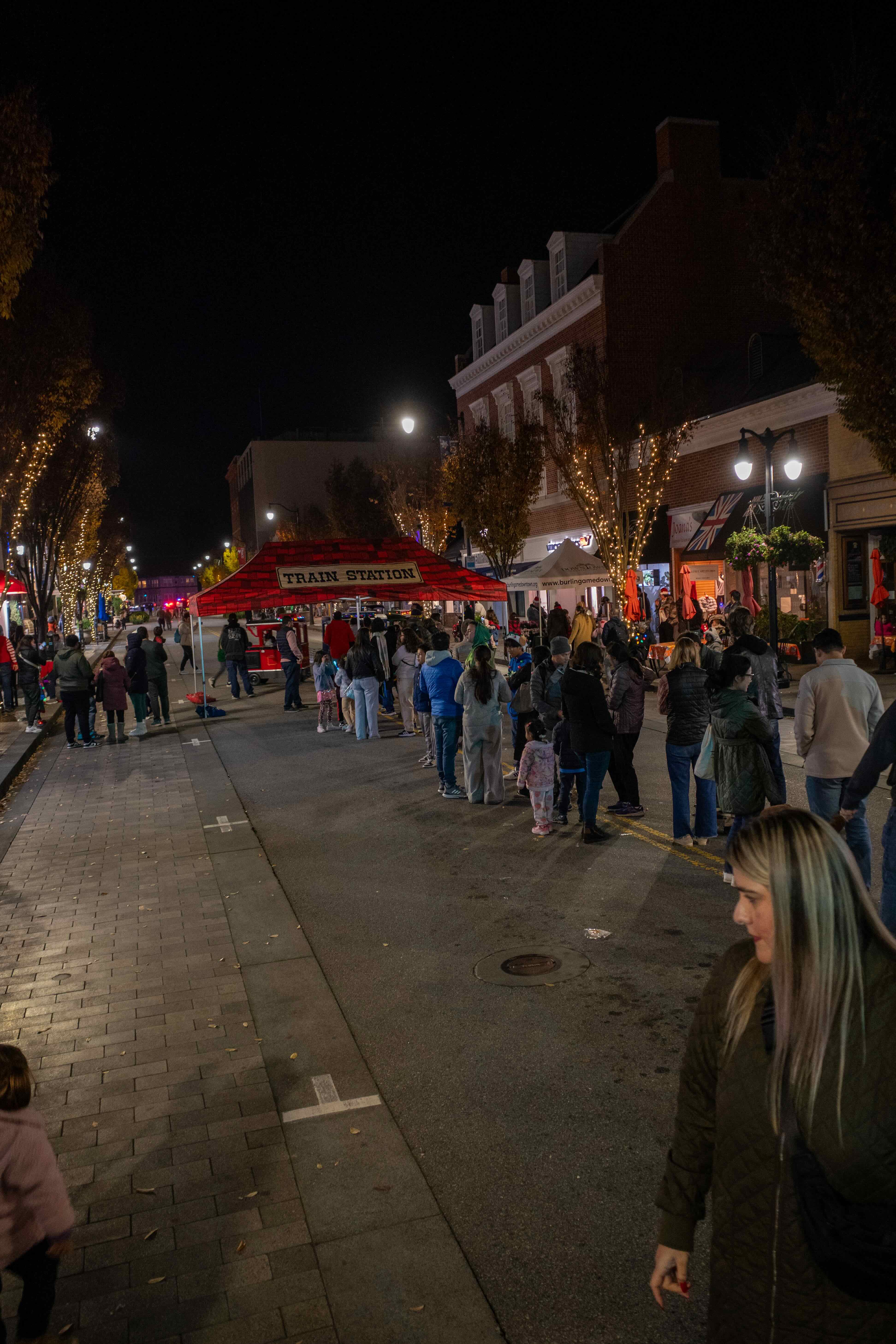
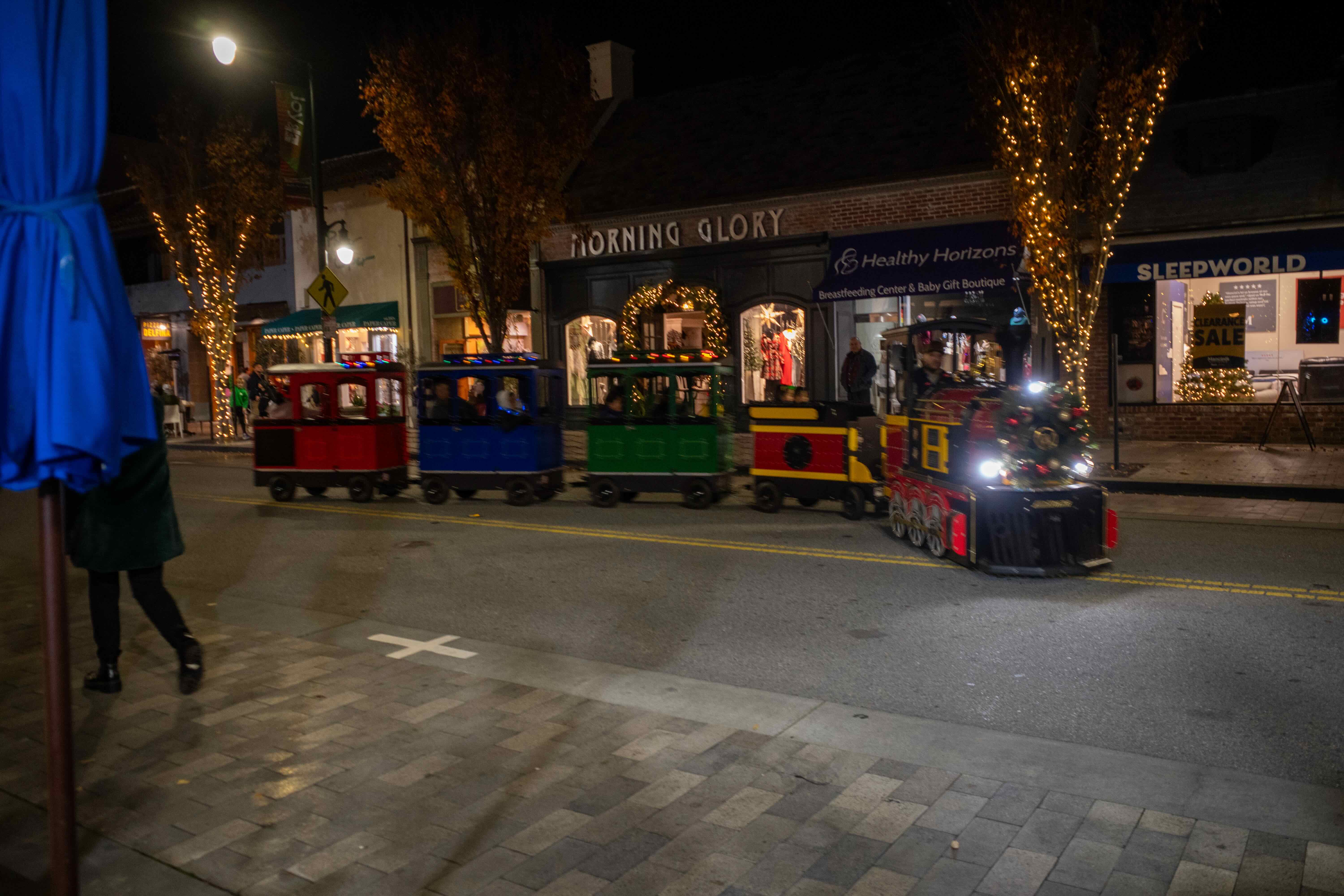 The train is silly. The line for it is not.
The street closure created the space. The train created the destination. People didn’t come because the road was closed. They came for the train and stayed for the shops. That’s the whole theory in miniature.
Why Farmers Markets Fail
While I label the farmers market for “beginners”, a lot of them quietly die.
Understanding why they die is useful if you want yours to survive and grow.
The most common failure is a chicken-and-egg problem between vendors and customers.
A market needs enough vendors to attract customers and enough customers to attract vendors.
Without the customers, farmers won’t renew their permits.
Without the vendors, customers stop coming.
A market with three stalls isn’t a market: it’s a sad parking lot, and once it gets that reputation recovery is hard.
The second failure is location and layout.
A market tucked behind a building, or oriented away from where foot traffic is coming from works against itself from day one.
Shade matters too—-a wide-open plaza with no tree cover is uncomfortable to linger in when it’s hot, and lingering is what you’re selling.
And don’t forget bathroom access.
The third is grant dependency.
Seed funding gets a market started, but a market that never develops real vendor and customer bases before the money runs out will collapse when it does.
Recurring paying customers are the only sustainable foundation.
The fourth is programming.
A market that’s only vegetables competes on produce.
A market with live music, a food truck, something for kids, and a reason to stay for an hour becomes a destination.
Destination markets generate the foot traffic that keeps vendors coming back season after season.
What Happens When the City Doesn’t Follow Through
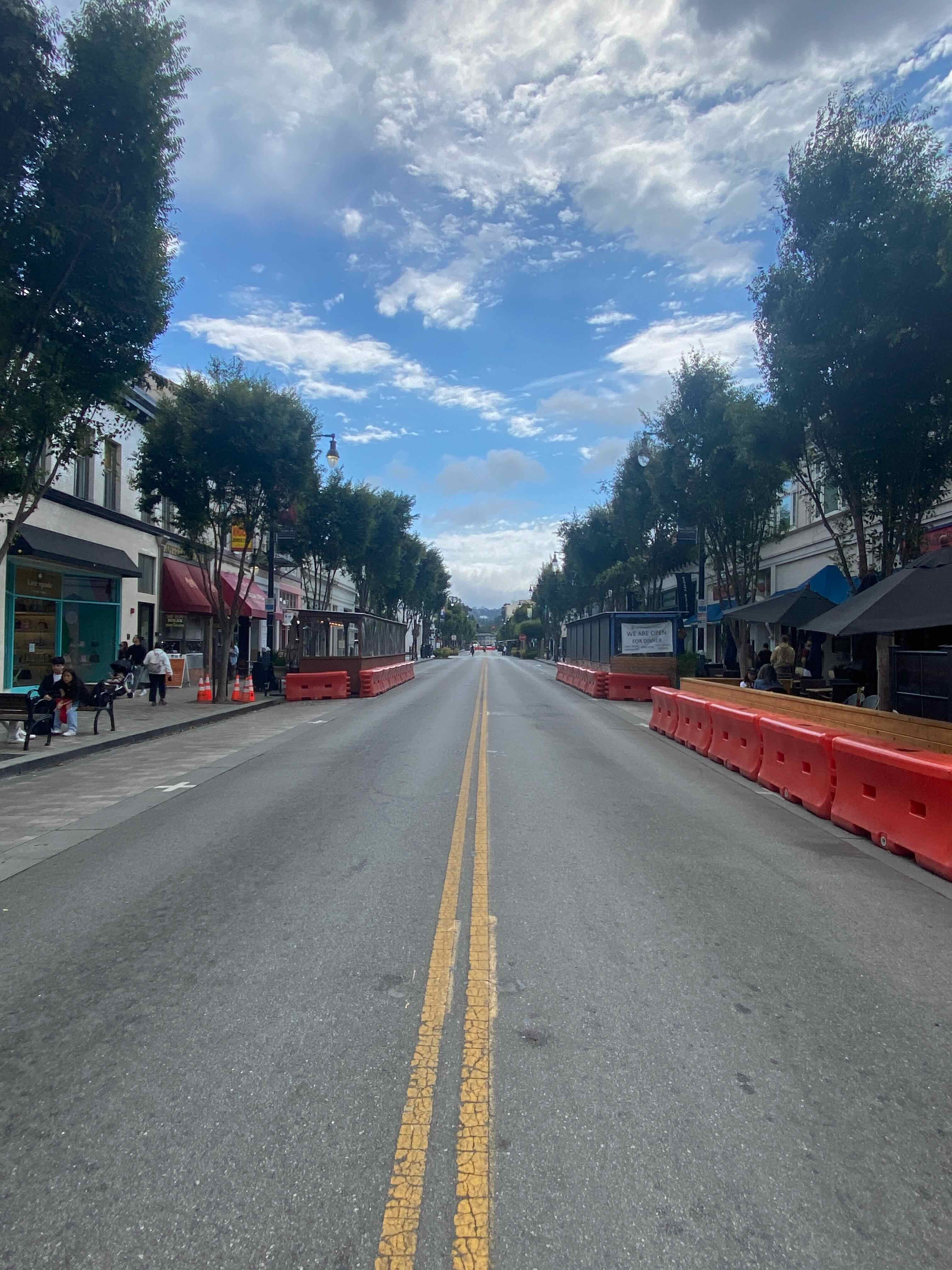 A weekday closure of Burlingame Avenue that almost nobody knew about. The city reportedly did little to no marketing, and the city manager left on vacation just before it launched. The bike racks are empty. The street is empty. This is not an argument against closing streets. It’s an argument against closing them and then doing nothing.
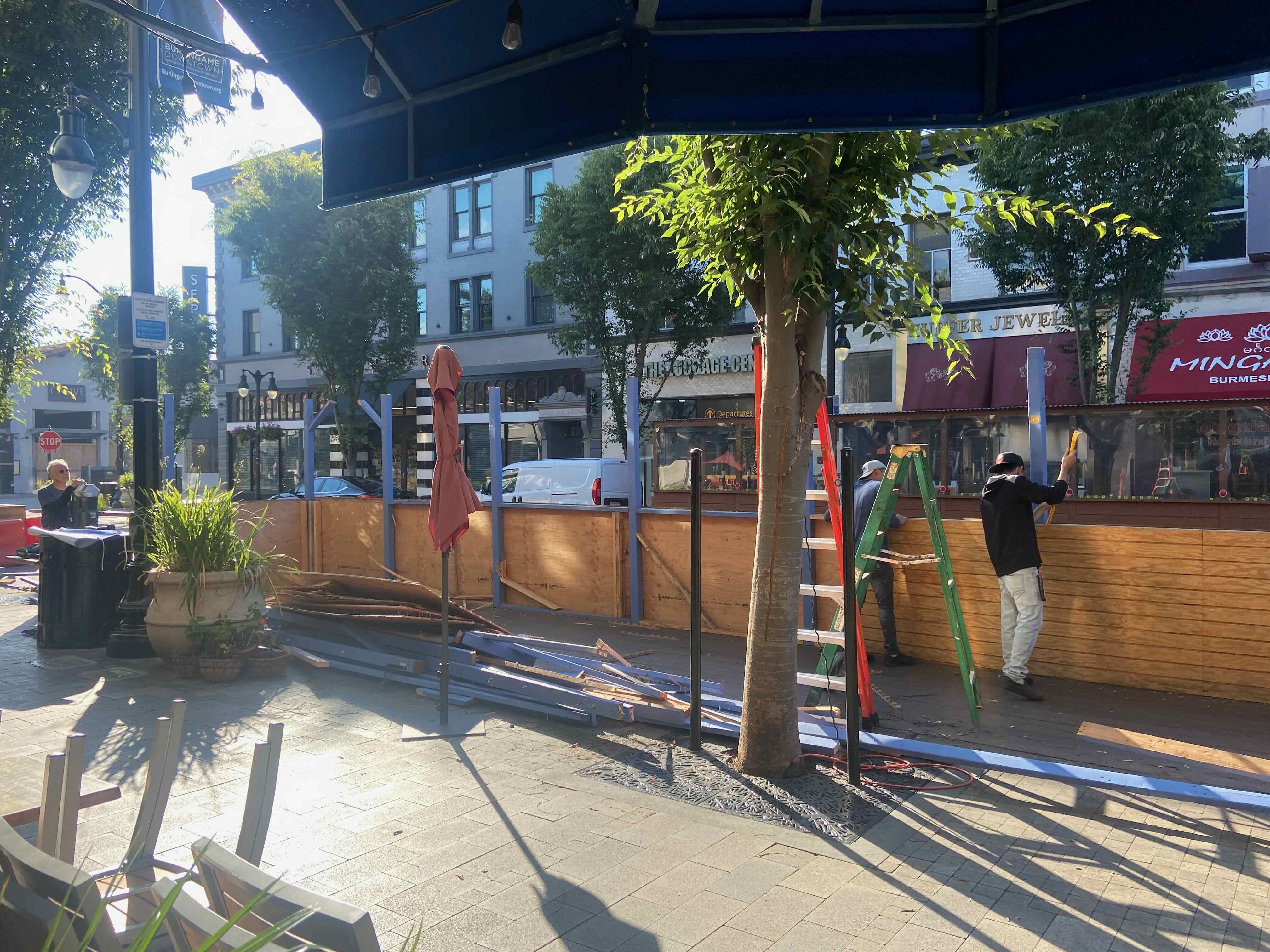 A COVID-era parklet being dismantled on Burlingame Avenue. Parklets built on car-accessible streets face strict structural standards for vehicle impact. When the cars come back, the parklets go. Allowing cars on a street has compounding costs.
The city creates the space. The city can also take it away.
The merchants who understand this are the ones who have the most to gain from locking in the closure before the next administration reconsiders it.
What You Can Actually Do
Show up and buy something.
The most basic contribution is also the most important.
Consistent customer volume is what keeps vendors renewing.
If you go once and the tomatoes are good, go again.
Make it a Saturday habit.
Bring someone who’s never been.
Farmers markets spread by word of mouth more than advertising.
A new customer who has a good first experience becomes a regular.
Spend time, not just money.
Linger. Sit down if there’s somewhere to sit. Talk to a vendor.
The case for converting a temporary closure into something permanent is built on foot traffic counts and dwell time.
Every extra minute on that block is a data point.
Put furniture on it.
The city creates the space but doesn’t always furnish it.
A group I’m part of called B Street Boosters fundraised for three picnic tables and placed them on the empty pedestrianized block while the city moved slowly:
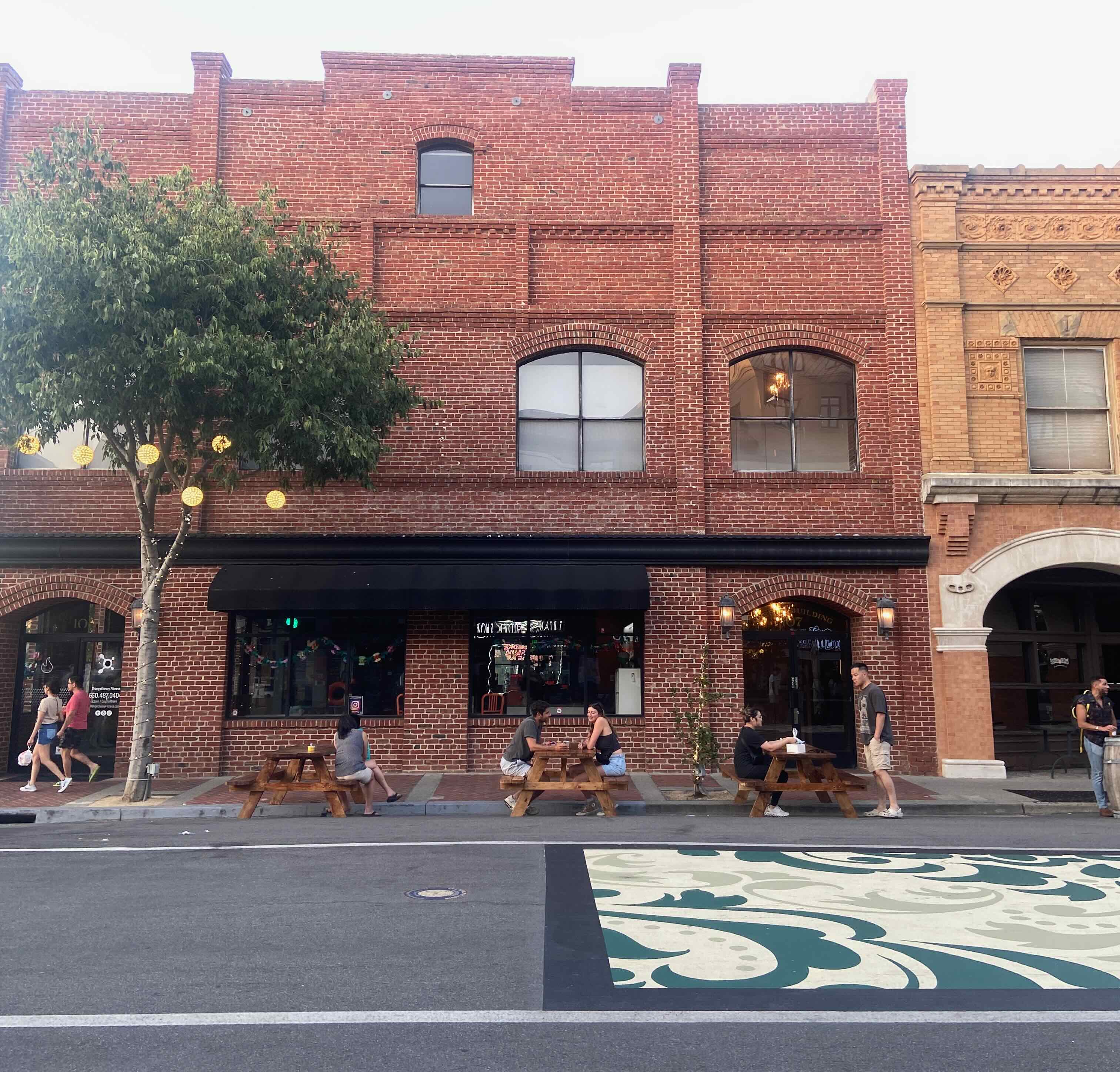 All three occupied the first time I walked by.
The city had created the space but hadn’t furnished it, so a small group of us raised money for picnic tables and put them there.
That’s the level of intervention that can move a street from empty to used.
Volunteer.
Most markets are understaffed. Setup, breakdown, staffing the information table.
This is what keeps management from burning out, which is one of the main reasons markets fail.
Help recruit vendors.
Know someone who makes jam, grows vegetables, does woodworking?
They can’t say yes if they are never asked!
Take on a bigger role.
If your market is fragile then someone needs to own it.
That might mean joining the organizing committee, taking over social media, or being the person who recruits new vendors each season.
Markets don’t grow by themselves.
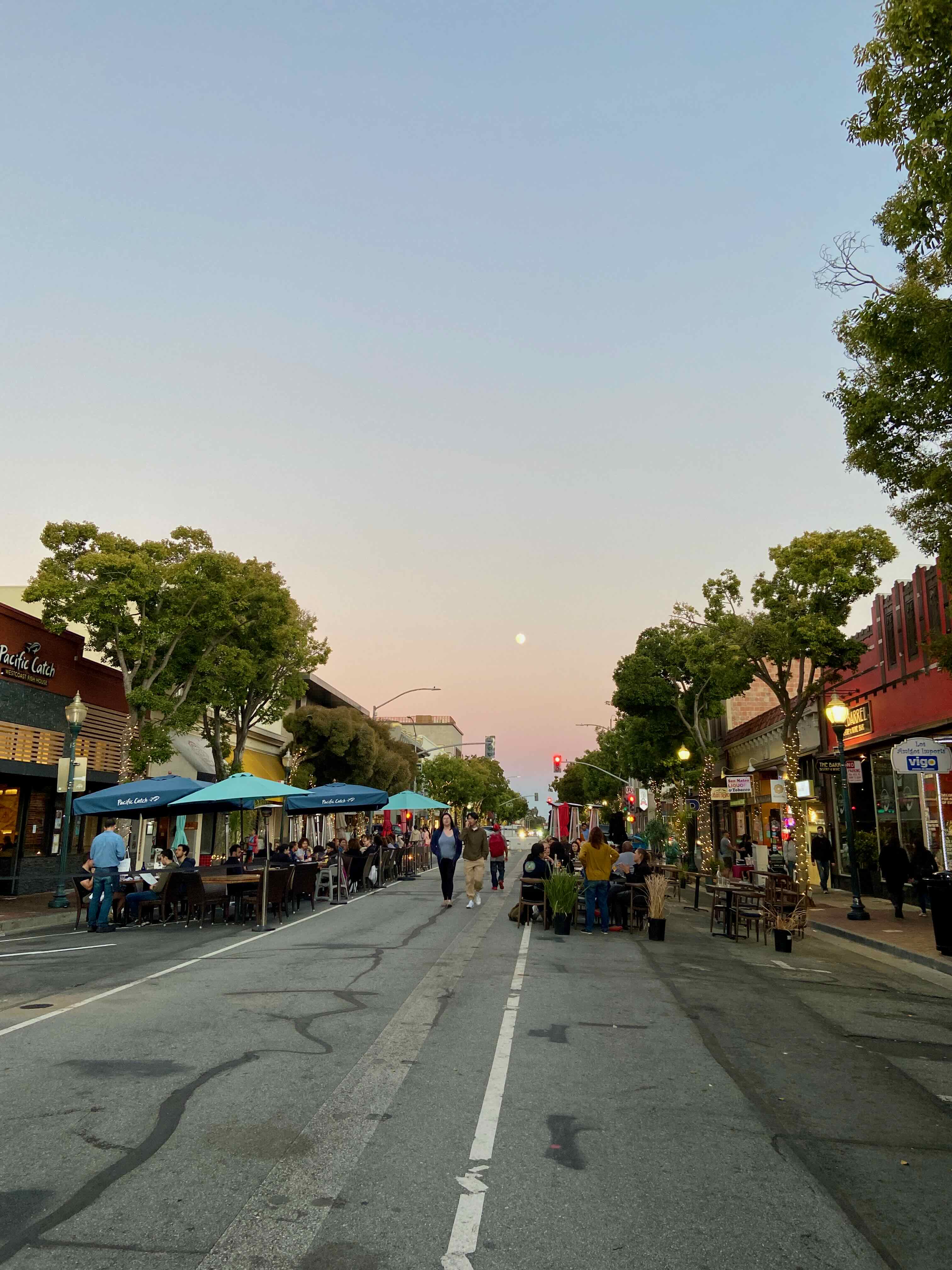 B Street before the mural. The street was already worth being on.
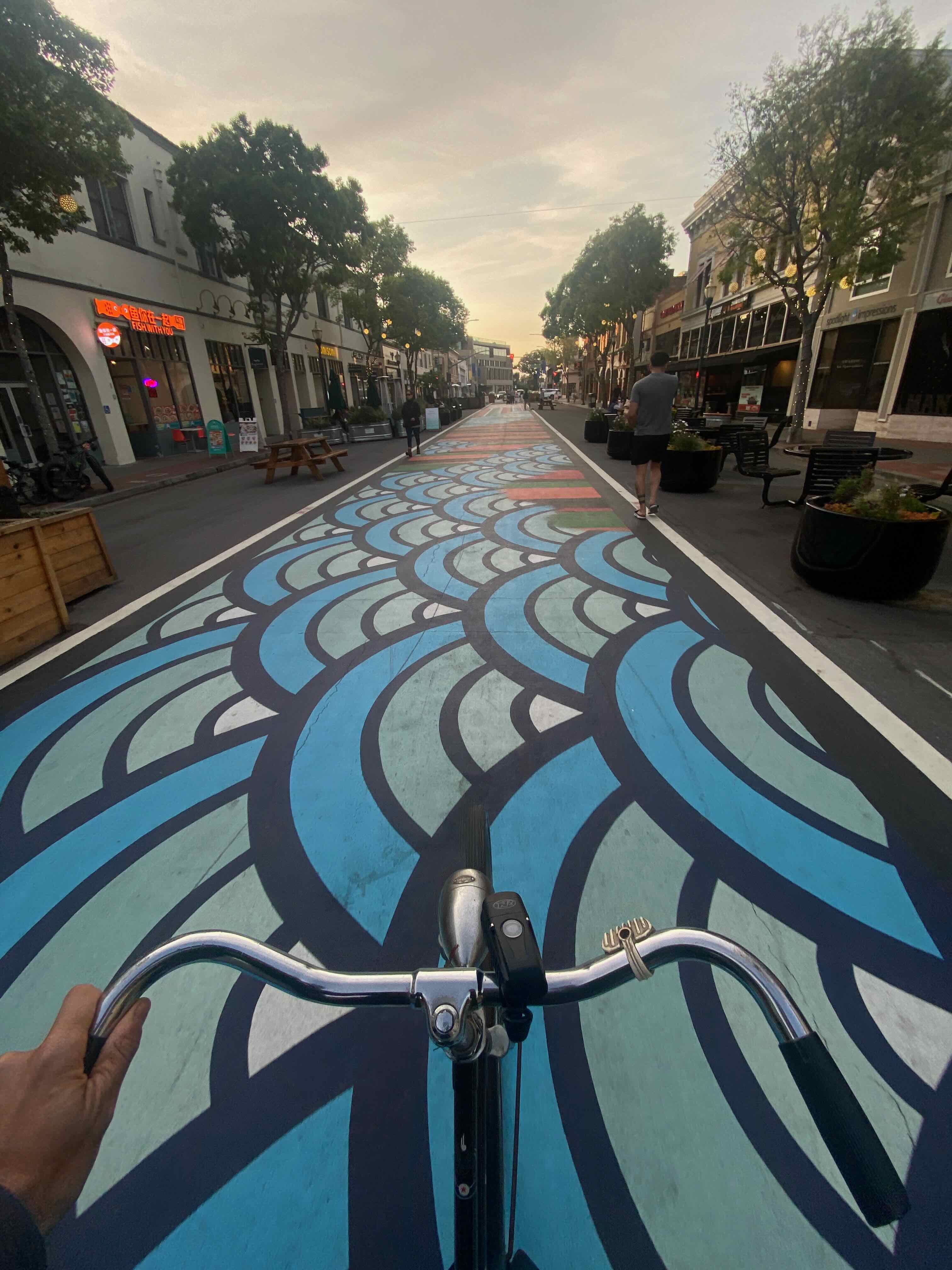 B Street in San Mateo. The city chose a street mural that will last 5-7 years over a bigger upfront hardscape investment. You don’t have to choose between a coat of paint and a full rebuild.
The street fair that becomes weekly market that becomes a seasonal open streets program that becomes a permanent pedestrian corridor.
That progression happens because someone started at the bottom of the ladder and kept climbing.
The pitch to a skeptical merchant or city council isn’t “look what Times Square did.”
It’s:
You know how it’s always busier on farmers market Saturdays?
We want to find out if we can make more Saturdays like that.
Start there.
Enjoyed this post? Get new posts via email