Essay
Measure RTM gives Caltrain ~$75 million a year. Its biggest savings are still on the table.

Measure RTM, which passed with ~62% of the vote in early counts, will charge shoppers in San Mateo and Santa Clara counties a half-cent sales tax for 14 years and give Caltrain ~$75 million a year, about the average yearly deficit Caltrain projects through 2034. The 6 strategies Caltrain adopted to qualify for that money are worth ~$5–11 million a year by my estimate, and most of that waits on an operator contract that cannot start until July 2029. The law behind RTM had each Bay Area transit agency look for savings on its own, and never asked them to pool what they buy, from insurance to supplies to contracts. Caltrain’s own documents point to savings in its train crews, a federal service waiver and its land, together worth more than twice the adopted list. Caltrain left its biggest savings options out of its adopted strategies.
Caltrain’s 6 strategies, adopted in June from a list in MTC’s Phase 1 efficiency review, are to:
- raise parking revenue,
- lease spare fiber-optic cable,
- study retail at stations,
- find efficiencies in the operator contract,
- study storing braking energy in batteries, and
- sign more employers up for GoPass, Caltrain’s bulk annual pass
The review put no dollar figure on any of them, so I made my own estimates from Caltrain’s numbers. They are my estimates, not the agency’s, and each one’s basis is in the chart data.
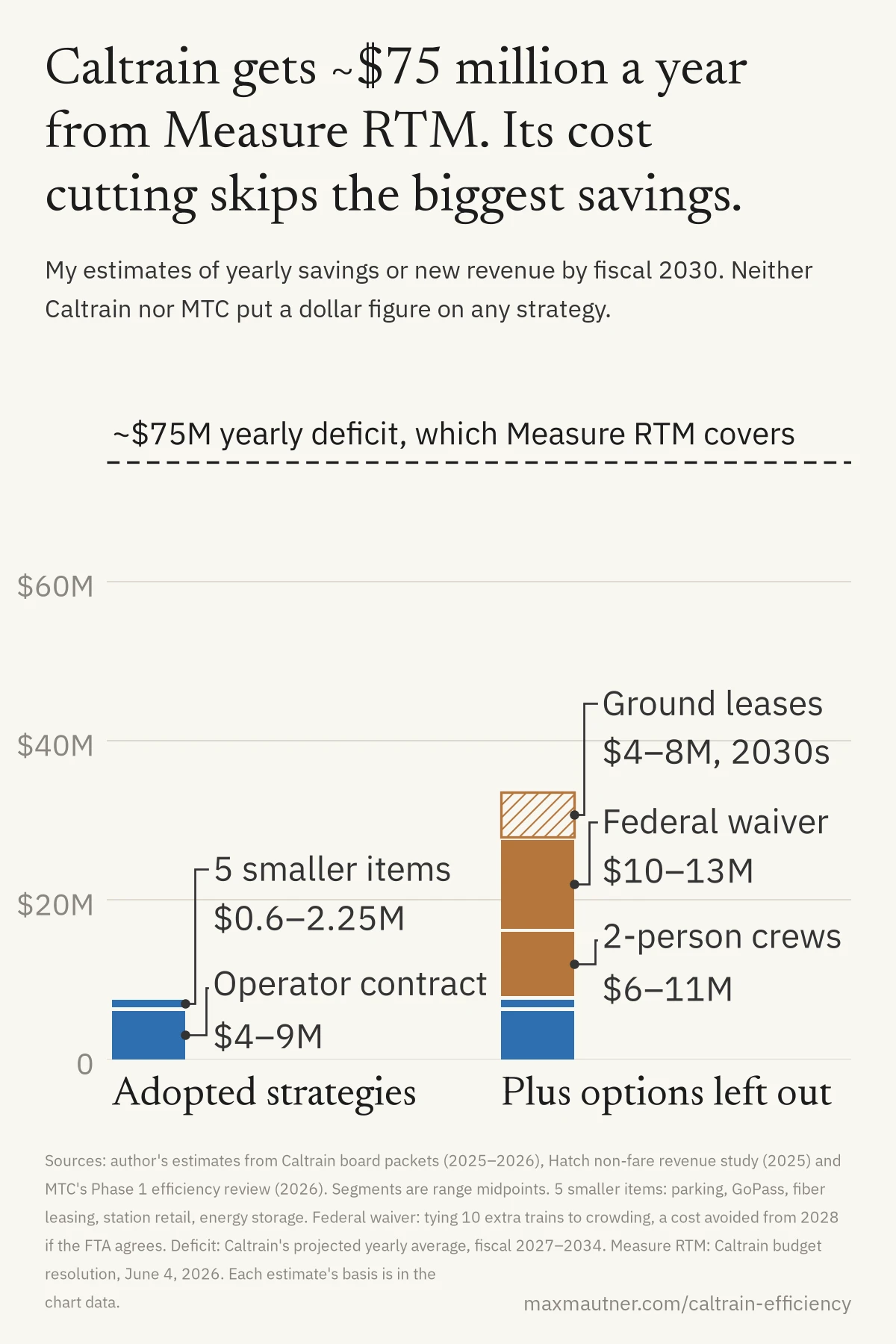
4 of the 6 are small because Caltrain’s own reports say so: leasing spare fiber optic cable (2) would bring in $100k–200k a year and “requires repair before marketable.” Caltrain’s request for battery proposals (5) found “no off-the-shelf solutions.” GoPass revenue is flat at $14.1 million, which the budget blames on “continued challenges with program participation,” and Stanford University and Stanford Health Care pay 69% of its program’s revenues. Parking (1) is harder to squeeze than it was: 13 stations were more than 80% full in 2019 while only 3 were at that level of utilization in 2025, according to Caltrain’s parking strategy.
The operator contract is the one strategy that could matter: $129 million of Caltrain’s $254 million operating budget this year goes to an operating contract with TransitAmerica Services (TASI) to run its trains. The budget calls it a “cost-plus-performance-fee” contract: Caltrain reimburses TASI’s costs, and TASI’s profit is a capped fee scored mostly on safety, on-time trains and paperwork. TASI is best placed to find savings in running the trains, but it keeps none of what it saves; the most it can earn for controlling costs is a slice of a $4.5 million fee on a contract worth $129 million this year.
Caltrain projects the operator contract costs to grow ~5% a year, to $214 million by 2035. In October 2025 the board voted 7–0 to negotiate a 2-year extension with TASI, pending the Federal Transit Administration’s sign-off, under a staff plan in which the next contract starts July 1, 2029. I estimate $1–3 million a year from administrative fixes during the extension and $4–9 million a year after a rebid, or ~2–5% of the $168 million Caltrain projects the contract to cost in fiscal 2030, the range a competitive rebid could plausibly save without changing service.
Caltrain deserves credit for what it has already cut. It saved $76 million in operating costs from 2020 to 2025, nearly half of it from crew scheduling and less overtime, and it now saves ~$4 million a year on electricity by changing how PG&E bills it.
SB 63, the state law behind Measure RTM, required MTC to review 4 agencies: AC Transit, BART, Caltrain and Muni. The review marked 2 strategies as core for all 4: improving fare compliance and improving speed and reliability. Neither appears among Caltrain’s 6, and the review gives no reason. The review also pushed 3 larger ideas to “future consideration” for every agency: reviewing labor contracts and staffing levels, buying jointly with other agencies, and finding contract savings “including paratransit, insurance.” Caltrain’s own plan for losing RTM, which its board adopted in June, lists asking the FTA to extend a waiver, cutting administrative staff and raising fares. None of those is among Caltrain’s 6 strategies either. Fares are at least moving: in December 2025 the board voted 7–1 to raise them by $0.25 each January through 2030, roughly tracking inflation.
Of 3 options in Caltrain’s own documents that its list leaves out, crew size is the largest lasting saving. Federal rules require at least 2 crew members on most trains, and an engineer plus 1 conductor meets that. Caltrain’s trains carry 3. Its 2011 operator contract set the crew at an engineer, a conductor and an assistant conductor, and invited TASI to try “non-traditional methods of onboard staffing.” In May 2026 a rider advocate wrote the board that 3-person crews are still standard, and that a train missing its assistant conductor saves nothing, because the remaining conductor collects the absent one’s pay. Writing a 2-person crew into the 2029 rebid would save, by my estimate, ~$6–11 million a year, or ~4–7% of the contract’s fiscal-2030 cost, after paying for roving fare inspectors and staff to help riders on platforms. That is also the fare-compliance strategy Caltrain dropped. Conductors handle emergencies and help riders who need assistance, which is why every train would keep 1 and the estimate pays for staff on platforms. Riders would see the same trains, and every train added later would cost less to run. This one is hard for Caltrain to do alone: its train crews work for TASI, and crew rules are set in TASI’s agreements with its unions, which Caltrain doesn’t sign. The engineers ratified a 5-year agreement with TASI in June 2025, and the conductors’ union reached a 5-year deal in April 2025 with raises dating back to July 2022. Neither union has published its agreement’s end date.
Caltrain’s electrification grant requires 114 weekday trains. Caltrain runs 104 under a waiver that lasts until Dec. 31, 2027 or until ridership returns to the 2019 average of 63,598 trips a weekday, and it “may request an extension.” The waiver saved $10 million in fiscal 2025 alone. Asking the FTA to tie the 10 extra trains to measured crowding at rush hour, rather than to a fixed count, would avoid ~$10–13 million a year from January 2028, by my estimate, scaling that year’s savings to a full year with cost growth. That is a cost avoided rather than a saving, and the FTA decides, but Caltrain’s own emergency plan already names it.
On land, MTC’s review found 4 vacant sites totaling 13.7 acres ready for development, plus 1.2 million square feet of offices already entitled at Diridon and a 7–8 million square foot application at the 4th and King railyard in San Francisco. Caltrain collects ~$1 million a year from commercial leases. At Hayward Park in San Mateo, a developer won approval for apartments on Caltrain land and then walked away when it couldn’t get financing. The review suggests replacing Caltrain’s rule that 30% of each project’s homes be affordable with a portfolio-wide goal, as BART and Muni use, so some sites can be fully affordable and others can pay for themselves. Caltrain’s consultant put ground leases at ~$4–8 million a year across the portfolio, mostly in the 2030s. That ties the operator contract in dollars and adds riders and homes besides.
Crew size and the waiver alone come to ~$16–24 million a year by 2030, more than twice the adopted list, before any land deal closes.
Savings no single agency can find on its own are in no agency’s plan, because SB 63 never required the agencies to save money together. Caltrain buys its own insurance coverage rather than sharing a policy with other agencies, and its insurance costs $19.7 million this year, up 27% in 1 year, yet its version of the contracts strategy covers only the operator contract, while BART’s names insurance. MTC’s reviewers suggested joint procurement and shared services, then deferred them, and listed shared procurement and consolidating functions across agencies among the ideas from public comment left for Phase 2. The law gave them no mandate to do more. Its first phase covered only steps that would improve service “with existing resources,” and nothing in it requires pooled insurance, joint purchasing, joint bargaining or merging agencies. A 2024 draft of the law included a study of “consolidation or enhanced coordination” of the agencies; the law that passed has none.
SamTrans already manages Caltrain, and charges it $6.8 million this year to do so, so 2 Peninsula agencies share staff today. On its largest cost, Caltrain bargains alone, as a small agency buying train crews from a contractor whose crew rules are set with the contractor’s unions.
Phase 2 starts in 2027. A consultant will draw up a “menu of cost-saving measures,” and each agency must adopt a plan to carry some of them out by August 2028 to keep receiving RTM money. The oversight committee can recommend changes to each plan, and an agency that rejects one has to say why in writing and renew that finding every year. The committee has added strategies before: the retail study on Caltrain’s list got there by a committee motion in May 2026. It can put pooled insurance, joint purchasing and crew size on the Phase 2 menu, and whether the agencies then follow through is something anyone can check. Crew size can’t wait for Phase 2. Caltrain’s board starts the formal procurement for its next operator contract in early 2027, and the crew it asks bidders to price then is the crew Caltrain will pay for from July 2029 on.
The charts are generated by this code, which lists every input and its source.
Enjoyed this post? Get new posts by email.