Essay
Bay Area transit gets an efficiency review. The 101 express lanes never got one.

Measure RTM appears to have passed. Its most prominent opponent, former BART director Debora Allen, wrote on Nov. 5 that SB 63, the law behind it, created “an oversight process that lacks meaningful independence and enforceable financial reforms.” She’s right about much of it. But the 101 express lanes, a ~$600 million highway project voters here also paid for, have even less oversight, and no law ever required them to have more.
Her October op-ed in the SF Standard spelled out what she means. The committee reviewing BART, Muni, Caltrain and AC Transit gives 4 of its 9 seats to those same agencies and the other 5 to MTC. Funding depends on agencies carrying out cost-saving plans they choose themselves, not on total costs going down. The review happens once, then the committee disbands, while the tax runs 14 years. VTA, which gets 84% of Santa Clara County’s revenue from the measure, is exempt. And there is no regional inspector general.
Several of these points are fair. The Phase One efficiency review counted deferred liabilities and cancelled planned raises as “savings” while total operating costs rose at all 4 agencies. BART’s costs grew faster than inflation while it carried 46% of its pre-pandemic riders.
Nobody is required to check, after the review ends, whether the agencies do what they promised, so I built a tracker that follows each of the Phase One review’s 35 recommendations against board actions and other public records. As of Nov. 4 the agencies have adopted 32 and none is yet marked implemented, and the review attached no dollar savings to any of them. The data is downloadable, and the tracker has an RSS feed for anyone who wants to follow along.
So apply Allen’s test to the US 101 express lanes in San Mateo County.
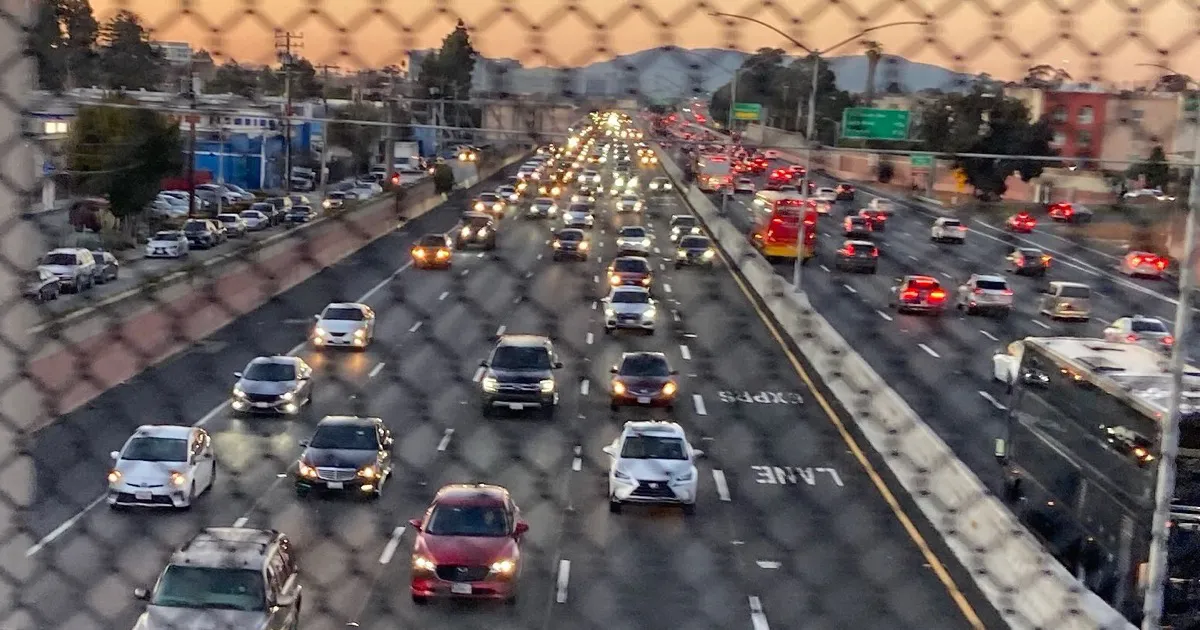
Photo: Max Mautner
The project’s $514 million budget came mostly from state gas taxes, Bay Area bridge tolls and San Mateo County’s Measure A sales tax.
| Allen’s test | Measure RTM | 101 express lanes |
|---|---|---|
| Overseers independent of the spenders | No | No |
| Oversight beyond an audit | No | No |
| Funding tied to lower total costs | No | No |
| Efficiency review | Once, flawed | Never |
| Oversight for the life of the tax | No, review ends | Advisory committee only |
| Permanent inspector general | No | State and federal share only |
The lanes are governed by a joint powers authority of 3 Transportation Authority board members and 3 C/CAG board members, the agencies that sponsored the project. Measure A, the county sales tax in the project, answers to a 15-member volunteer committee that gives the Transportation Authority board input on its projects. That is less than the “math-checking” Allen dismisses in SB 63. No efficiency review was ever required. No funding was conditioned on costs. Streetsblog put the finished project near $600 million.
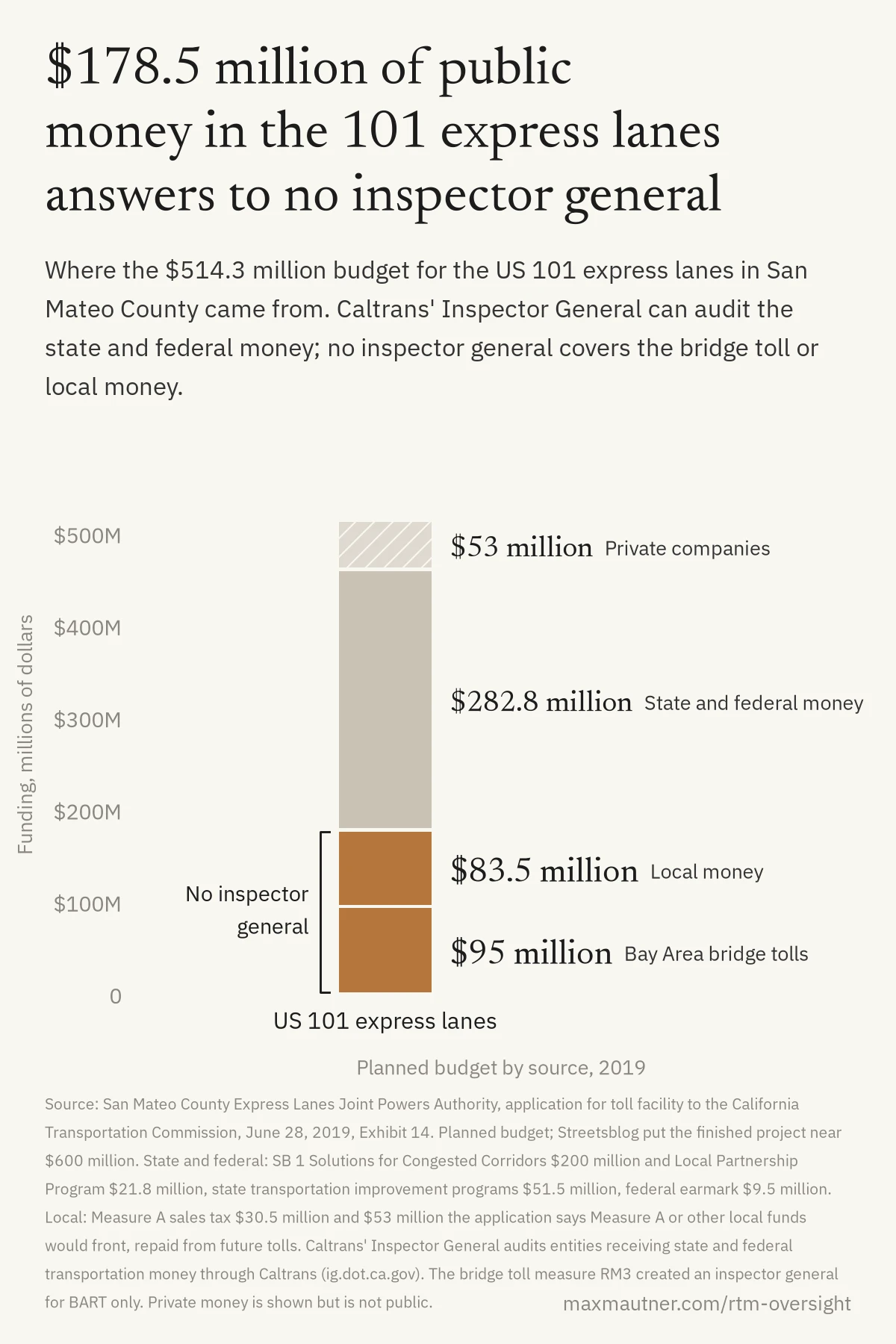
The lanes do better than RTM on only 1 test, and only by accident. Because state and federal money passed through Caltrans, its Inspector General can audit that share. No inspector general covers the bridge tolls or the local money, $178.5 million between them. None of this shows the lanes are badly run. It shows transit is held to a test the highway was never asked to pass.
The people who built the lanes also grade the results. A 2024 report to the county’s cities found the regular lanes next to the express lanes slowing, below 30 mph at some times and places. The express lanes authority’s own 2026 performance study found faster speeds in both kinds of lanes, measured against traffic before the extra lane was added, and its authors told the Transportation Authority board the next version would be peer reviewed.
The last regional transportation measure had the same double standard. RM3, the 2018 bridge toll increase, funds $4.45 billion in highway and transit projects, including $300 million for express lanes. It created an independent inspector general for 1 recipient: BART.
The lanes’ 1 real defense is that they pay their way. Tolls now cover their operating costs with room to spare, and the express lanes authority is paying down its construction loan ahead of schedule. That loan is also where the sales tax comes back in. Its $100 million came from Transportation Authority bonds secured by the county’s sales taxes, due by 2049, so if tolls fall short, San Mateo County shoppers cover the gap for 29 years, twice as long as RTM’s tax runs.
The defense also leaves the regular lanes beside the express lanes out of the accounting. Caltrans expects to have ~59% of what it needs to keep the state’s highways in repair over the next 10 years, a $45.5 billion gap, and part of the money it does have is federal highway money that Congress keeps refilling from income taxes. BART fares covered ~23% of BART’s operating costs in fiscal 2025. One of these gaps gets called a fiscal cliff, and the other doesn’t get called anything.
I don’t think either one needs an inspector general. But anyone who calls RTM’s oversight too weak should say the same about the 101 express lanes, which have less. A standard applied only to transit isn’t an accountability standard. It’s an argument against transit.
The charts are generated by this code, which lists every input and its source.
Enjoyed this post? Get new posts by email.