Essay
In the US, trains carry freight. In Japan, they carry people.

The average American travels about 45 miles a year by train. The average person in Japan travels about 1,750. Yet American railroads haul about 45 times as much freight per person as Japan’s. American freight rail works, and that is the problem for passengers: the same 1970 law that rescued the freight railroads let them stop carrying people, and the trains that remain run as guests on track the freight companies own.
Caltrain is the exception that shows how it could work. A public agency bought the Peninsula corridor from Southern Pacific in December 1991, and Union Pacific kept the right to run freight on it, so between San Francisco and San Jose the passenger railroad is the landlord and freight is the tenant. Across most of the country it is the reverse, and Amtrak runs when the freight railroads let it.
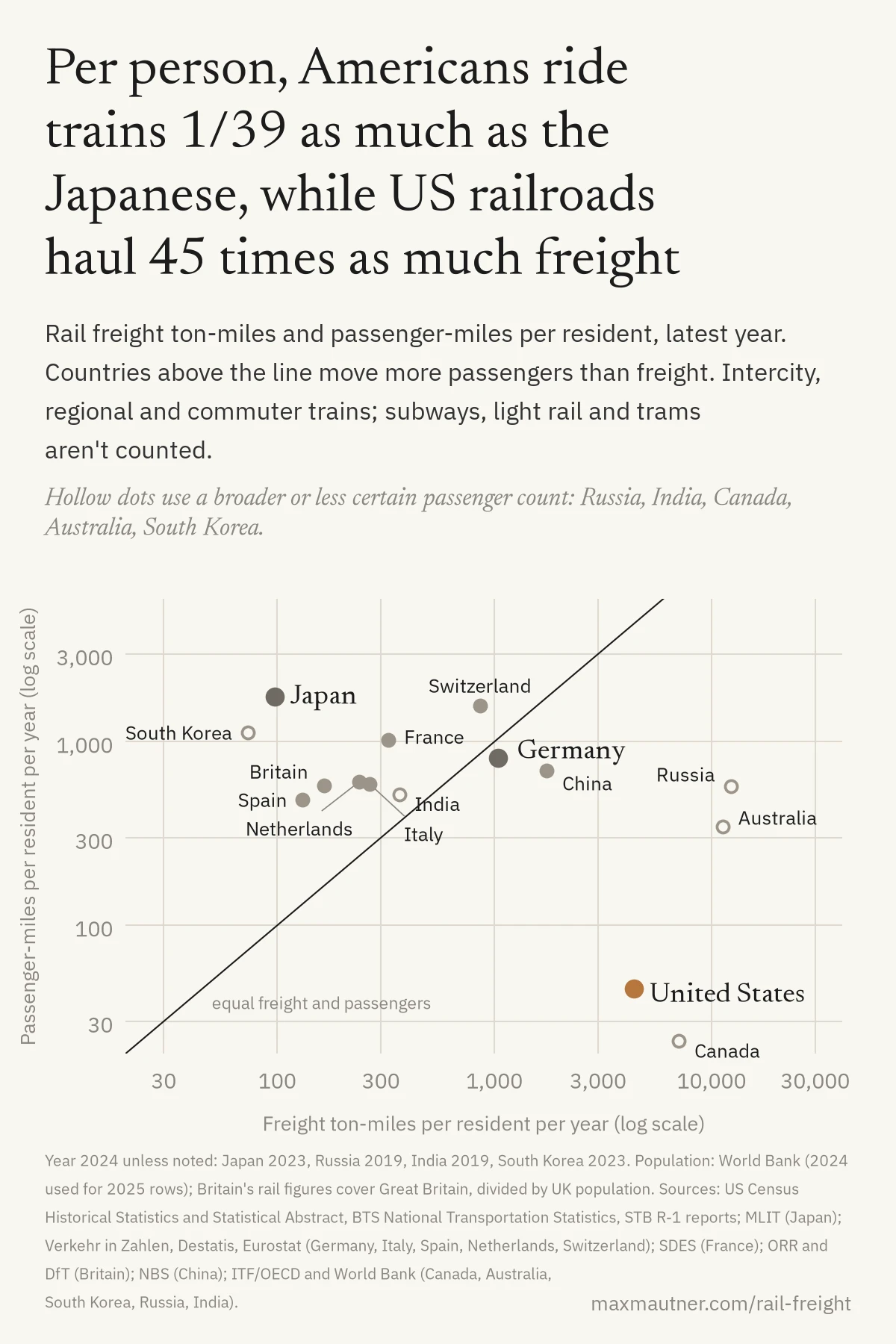
Europe sits in between: Germany’s trains haul ~1.3 tons of freight a mile for every person they carry a mile. Geography explains part of the American number: Australia, Canada and Russia, huge and full of ore and grain, also run freight-heavy. China is a continent of coal mines too, yet its trains haul only ~2.5 tons of freight for every person.
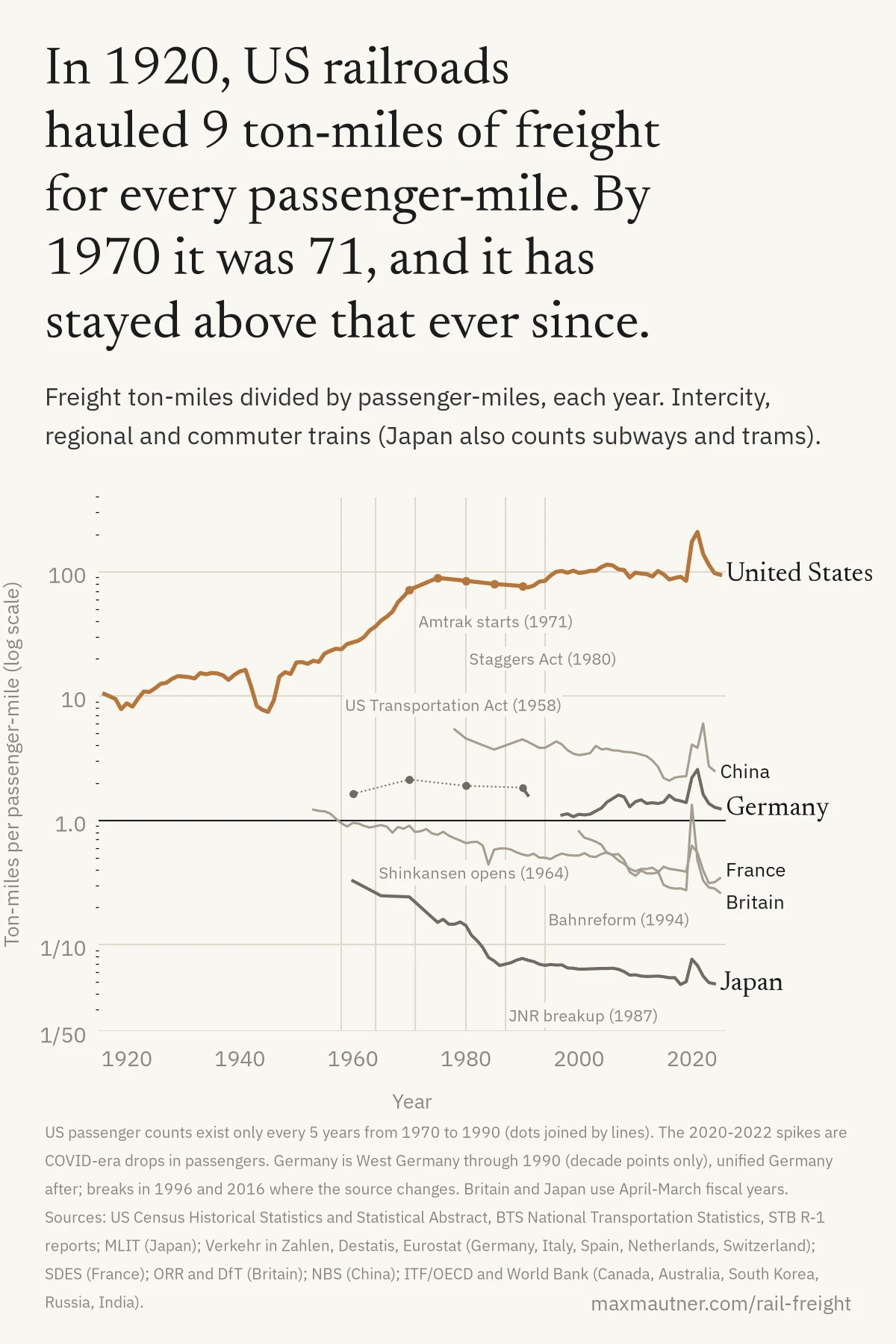
The American number climbed because passengers left. Between 1920 and 1970, passenger travel on US railroads fell 77% while freight grew 86%. The Transportation Act of 1958 let railroads drop interstate trains by posting advance notice, and by 1970 the track carrying passenger trains had shrunk by more than half.
Penn Central, the largest railroad in the Northeast, went bankrupt in June 1970. 4 months later, Congress relieved the railroads of the requirement to keep carrying passengers and handed what was left to Amtrak. Jim McClellan, who worked on the plan at the Federal Railroad Administration, later wrote: “The collapse of passenger railroading was acceptable; the collapse of freight railroading was not.”
Japan and Germany restructured their railways too, and kept the passenger as the landlord. When Japan split its national railway in 1987, the track went to 6 passenger companies, and JR Freight pays them access charges that researchers find too low to cover the track’s upkeep. Germany merged its 2 state railways in 1994 into one company the federal government still owns outright.
Since 1973, federal law has given Amtrak trains priority over freight on shared track, but only the Attorney General can sue to enforce it. The Justice Department’s latest suit, against Norfolk Southern, settled in September 2025 with a promise to dispatch Amtrak first on 1 route, the Crescent from New York to New Orleans. On every other route, Amtrak’s place in line depends on the Attorney General deciding to sue.
The charts are generated by this code, which lists every input and its source.
Enjoyed this post? Get new posts by email.