Essay
Measure RTM gives BART ~$310 million a year. Its biggest savings depend on union contracts that end in June 2027.

BART’s contracts with its 3 largest unions end on June 30, 2027, ~9 months before the state-required review of its costs is due. Those contracts set the price of BART’s largest cost, its workforce, and what BART agrees to at that table will matter more than the efficiency strategies it adopted to qualify for money from Measure RTM, the transit tax Bay Area voters just passed. By my estimate the strategies are worth ~$5–18 million a year, and no one outside BART is set to review the contracts.
The largest choice at that table is whether the new contracts leave BART free to run trains without an operator aboard. BART’s new train control system could allow it, and by my estimate driverless trains would save ~$50–75 million a year, about the size of the deficit BART forecasts even with the new tax. Those savings couldn’t start before the 2030s, and they come before the cost of platform doors and other equipment.
Measure RTM will give BART ~$310 million a year, less than its ~$375 million yearly gap. Even with the tax, BART’s own forecast shows deficits through 2031, the largest in fiscal 2028. Caltrain’s share of RTM roughly matches its average projected deficit; BART’s doesn’t.
BART’s 9 strategies, adopted in June from a list in MTC’s Phase 1 efficiency review, are to:
- tune the new fare gates to cut fare evasion further,
- raise parking revenue,
- lease more fiber optic cable and cell equipment,
- study retail at stations,
- study ways to make trips faster and more reliable,
- run shorter trains when fewer people ride,
- explore renegotiating its station lease at SFO,
- look for savings in contracts such as insurance and paratransit, and
- sign more employers up for BayPass, the region’s bulk transit pass
The review put no dollar figure on any of them, so I made my own estimates from BART’s numbers, counting only what isn’t already in BART’s budget for this year. They are my estimates, not the agency’s, and each one’s basis, with every source this post relies on, is in the chart data.
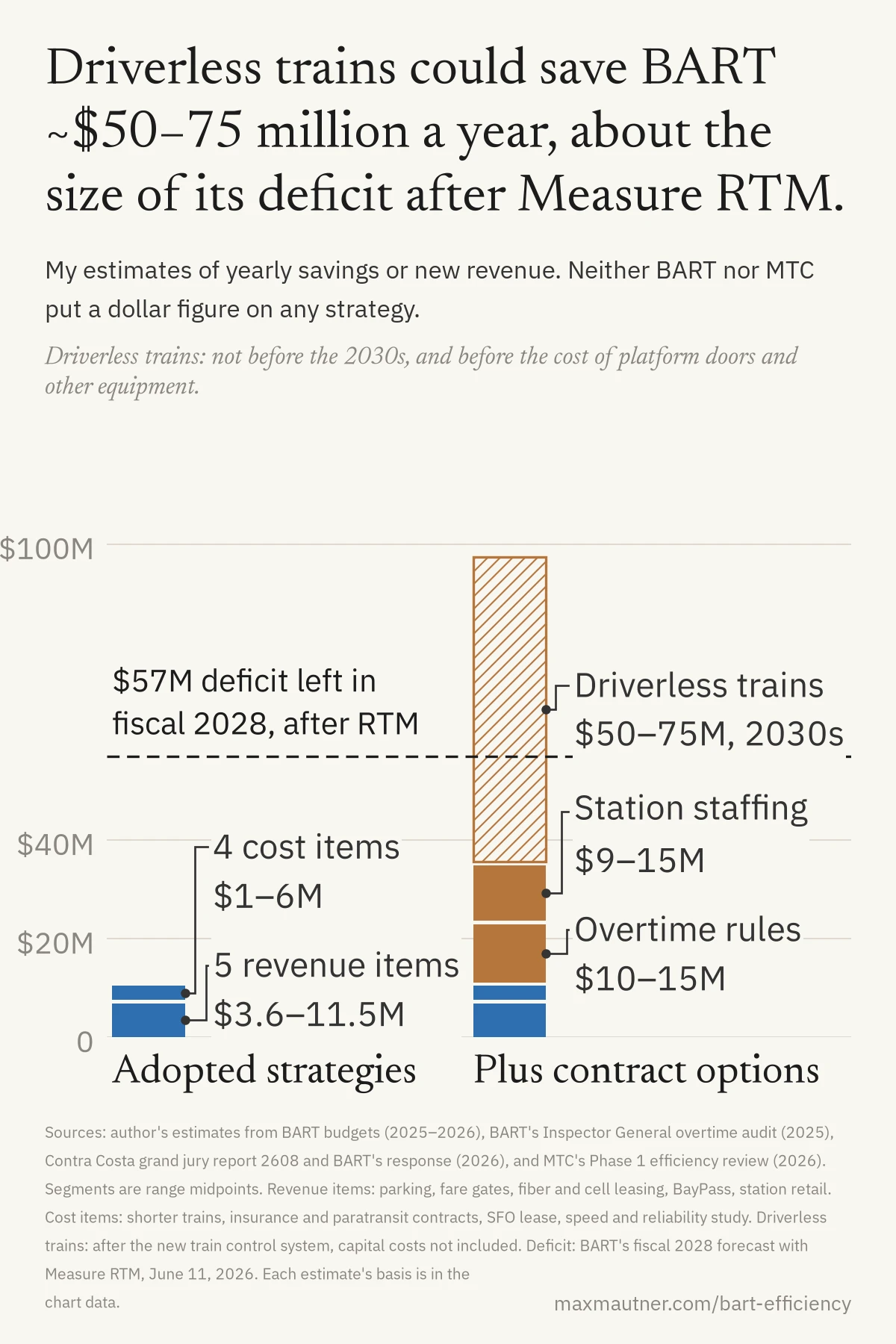
Most of the 9 are small because BART has already done them. The new fare gates, shorter trains, fiber and cell leases and BayPass already bring in or save ~$37 million a year between them, and the strategies ask for more of the same. Parking is already paid every weekday until 3 p.m., and BART raised fees in July at the stations whose lots were full. The SFO lease can save at most the rent BART pays, $2.5 million a year, and BART and AC Transit rehired their shared paratransit contractor in 2024, so that contract won’t come up again until ~2029.
BART deserves credit for what it has already cut: $516 million in operating costs from 2020 to 2025. By its own count its cost per hour of train service is middling among U.S. subways. Against peers BART itself uses for comparison, a Contra Costa civil grand jury found this year that BART carries the fewest riders per hour of service and spends the most per trip. In 2025 it ran more hours of service than in 2019 while carrying riders less than half as many miles.
Labor is 73% of BART’s costs, and the review left it alone. MTC pushed “review labor contracts and right-size personnel” to “future consideration” for every agency, and assigned incentives to cut absences only to the bus agencies. BART’s agreements with ATU, SEIU and AFSCME, the unions for its train operators and station agents, its maintenance and clerical workers, and its professional staff, all end June 30, 2027, and its police unions’ agreements are listed as ending this year. The second phase of the review, the one meant to produce a “menu of cost-saving measures,” is expected in spring 2028. BART says bargaining begins before the contracts end, so by then it will likely have signed contracts that run for years.
BART paid $80.9 million in overtime in fiscal 2024, ~14% of what it paid employees. BART’s inspector general found rules that make overtime easy to earn: under most contracts a paid sick or vacation day counts as time worked, so an employee can take a weekday off and still earn overtime on a regular day off; skipped breaks are paid as overtime in some jobs; some days off pay double; and BART caps no one’s overtime. In June the grand jury found most of the inspector general’s recommendations unimplemented. BART replied that it has since begun requiring a reason for every overtime hour, and that work rules “are a normal bargaining topic.” Rewriting those rules in 2027 would save ~$10–15 million a year by my estimate, after paying for some of the hours at regular rates.
The contract with ATU sets minimum staff by station rather than by how many people ride, for jobs that make up ~11% of BART’s workforce. BART told the grand jury those rules “do not serve as a significant constraint on staffing flexibility” and that “all potential bargaining proposals would be evaluated and considered.” Setting station staff by demand, and reaching it by not replacing people who leave, would save ~$9–15 million a year by my estimate. BART credits more staff in stations, along with police and new fare gates, with a drop in crime per rider, so the estimate keeps a third of the freed positions on platforms and trains, where riders see them.
BART has 486 train operators. Washington’s Metro, which BART calls one of its closest peers, backed a plan this year under which Red Line trains could run without a worker aboard by 2033. When BART directors asked in 2018 whether the new train control system would allow the same, the general manager answered, “If the board says that’s the future, we need direction from the board.” I found no record that it has. My estimate keeps part of the operators’ pay for roving attendants and control staff, and leaves out platform doors and other equipment. The 2027 contracts decide whether that choice stays open.
In August BART’s board turned down the grand jury’s recommendation to tie service levels to ridership, replying that it “will not be implemented.” Cutting service saves BART less than it looks: its plan for losing RTM found that a 70% cut in service hours would save only ~$176 million, and it was ready to make deep cuts to maintenance, police, cleaning and administration as an emergency measure rather than a saving BART would choose. What the grand jury asked for was a standard: BART’s board has none for judging whether service matches ridership.
Savings no single agency can find on its own are in no agency’s plan, as with Caltrain. Where agencies have pooled, it works: BART and AC Transit hire East Bay Paratransit together. Everything else is agency by agency. BART insures itself, and its claims cost $41 million in 2025. It bargains its contracts on its own calendar while AC Transit, Muni and Caltrain’s contractor bargain on theirs. MTC’s reviewers suggested joint purchasing and shared services, then deferred them. The state law behind RTM covered only steps that would improve service “with existing resources” and requires none of this. A 2024 draft of the law included a study of “consolidation or enhanced coordination” of the agencies; the law that passed has none. Bargaining jointly across agencies would take new law or new agreements among the agencies.
The state law sets the review last. Phase 2 will draw up its menu after BART’s contracts are signed, each agency must then adopt a plan to carry out some of it to keep receiving RTM money, and an agency that rejects a recommendation has to say why in writing and renew that finding every year. A multi-year contract signed in 2027 is the kind of reason an agency could give; that is my reading, not something the law says. So the review comes too late for BART’s biggest costs unless someone acts before then. BART’s managers owe the board’s audit committee an update on location-based staffing by the end of November. BART’s board can publish its bargaining goals for overtime, station staffing and train operators before it reaches tentative agreements, measured against the savings Phase 2 is meant to find, and the oversight committee can say what it expects before the contracts are ratified. Whether either happens is something anyone can check on a tracker I built for that purpose, and the contracts expire on June 30, 2027.
The charts are generated by this code, which lists every input and its source.
Enjoyed this post? Get new posts by email.