Essay · TRANSPORTATION
Most People Who Ride Bikes Have Soft Tires

Last week I argued that gear-shifting competency is an underexamined barrier to bicycling. Then a friend called me 10 minutes before a group ride I’d invited him to, panicking — both his tires were flat and he didn’t own a pump. He ran his bike over to the meeting point on foot. We inflated his tires with another rider’s hand pump, I walked him through it, and he made the ride.
He’s a competent adult who wanted to bike. The thing that almost stopped him wasn’t the route, the traffic, or the hill. It was air.
This is the bicycle’s quietest barrier. It’s also the one almost nobody talks about.
Tires lose air whether you ride or not
Bike tires lose air on their own, even when the bike is sitting in the garage. Skinny, hard tires lose air faster than fat, soft ones — but every type drops noticeably within 1-2 weeks.
If you ride daily, you feel the softness immediately and you keep a pump handy to re-inflate the tires.
If you ride infrequently, which describes most people who own a bicycle, you reach for the bike and might find the bicycle unrideably slow.
Without a pump and the know-how to use it, you have two choices: don’t ride, or ride on soft tires and risk ruining the tire. Most elect to abandon the bike ride.
The pump has a learning curve
To inflate a bicycle tire you need:
- A pump that matches your valve type (Presta vs Schrader — most adults don’t know there are two)
- Knowledge of the correct tire pressure that is appropriate, which is printed in tiny letters on the side of the tire (PSI or BAR) with a minimum and maximum
- The skill to attach the pump head properly
- The familiarity to read a pressure gauge and stop at the right number
None of this is “hard”. But all of it is unfamiliar to someone who has only ever pumped a car tire at a gas station, which is most American adults. A first encounter with a Presta valve is an exercise in “is this thing broken?” The little brass nut you have to unscrew before pumping is not intuitive.
Diagnosing whether the tire even needs air is its own skill. Experienced bicyclists pinch the tire and can guess whether a tire is adequately inflated. The pump itself is an overwhelming set of decisions: floor, hand, mini, CO2 cartridge, battery-operated? Each has different prices and use cases. A would-be cyclist trying to do the right thing has half a dozen decisions to make when first pump-shopping.
Until you know how to reinflate your bicycle’s tires, your bike will be unrideable after 1-3 months.
How big a drag is this on adoption?
No one has cleanly measured it, but we can estimate it:
- A 2022 Ipsos survey found 42% of adults globally own a bicycle, but only 14% use one for a short neighborhood trip. The gap between “owns” and “uses” is large, and is the entire scope of the problem if you care about driving bicycle adoption.
- Bikeshare ridership is robust in cities that build for it precisely because the bikeshare operator handles all maintenance, including keeping tire pressure topped up. Whatever portion of bikeshare users would otherwise be riding their own bike is a signal of how many would-be cyclists are blocked by maintenance friction.
- Bike shops sell “tune-up” services as a paid product because a meaningful share of owners would rather hand over $80–150 once a year than learn to do it themselves, which reveals many (most?) consumers’ preference for outsourcing maintenance.
My personal guess: somewhere between 10–25% of would-be bicycle trips that don’t happen are aborted due to tire pressure issues.
This compounds with every other barrier: gears, route-finding, weather, traffic anxiety, fear of theft.
A would-be bike rider who clears all of these hurdles can still be defeated by a deflated tube on the day they finally feel motivated.
For transportation bicycling specifically, the effect is worse as transportation depends on reliability.
If 20% of mornings starts with “the tires are flat and now I’m late” bicycling fails the basic test of being a transportation mode.
The would-be bike rider drives or takes a rideshare and the bicycle quietly retreats to being a purely recreational object.
What car owners deal with instead
I don’t think much about cars anymore, but the equivalent car-maintenance load is genuinely larger. It’s just outsourced and time-shifted.
A car’s tires need air maybe 2x a year vs. a bicycle’s 8-20x, and modern cars warn you with a dashboard light. Most drivers inflate their own tires in 5-10 minutes at a gas station. Thanks to modern tire pressure monitoring systems the deflated tire risk creates less uncertainty.
The rest of the car-maintenance burden (oil changes, brake pads, transmission fluid, the check engine light, registration, smog, the $1,500 surprise repair) adds up to $1,000s and many hours per year. The driver doesn’t experience tire pressure as a barrier to driving because pressing the ignition is easier than perform a pre-flight check on a bicycle.
The bicycle inverts this: total annual maintenance is tiny ($30–100 for most riders), but you feel the “work” of maintenancing a bike at the moment you mount it to ride it.
You can largely outsource your bike’s maintenance, but you can’t outsource tire pressure unless you live above your bike shop.
Cars cost staggeringly more in dollars, time, and distress than bicycles - but while the bike costs less its costs are timed to inconvenience you exactly when you want to ride.
The kickscooter dodges this entirely
As I argued earlier this month, the un-motorized kickscooter has a near-flat learning curve and a near-zero maintenance burden. Most sidewalk-riding kickscooters have solid polyurethane wheels: no tube, no valve, no pump. The wheel is forever ready.
That readiness comes at a real cost in ride quality and efficiency — the bike is 2–3x more efficient than kickscooters so if you are minimizing sweatiness you should definitely learn how to pump your bike’s tire and pick the bike.
The pump barrier is one of the under-discussed reasons the kickscooter punches above its weight as a last-mile tool.
Bike share fully solves this
The kickscooter dodges the maintenance question by having no maintenance. Bike share dodges it by handing the maintenance to someone else.
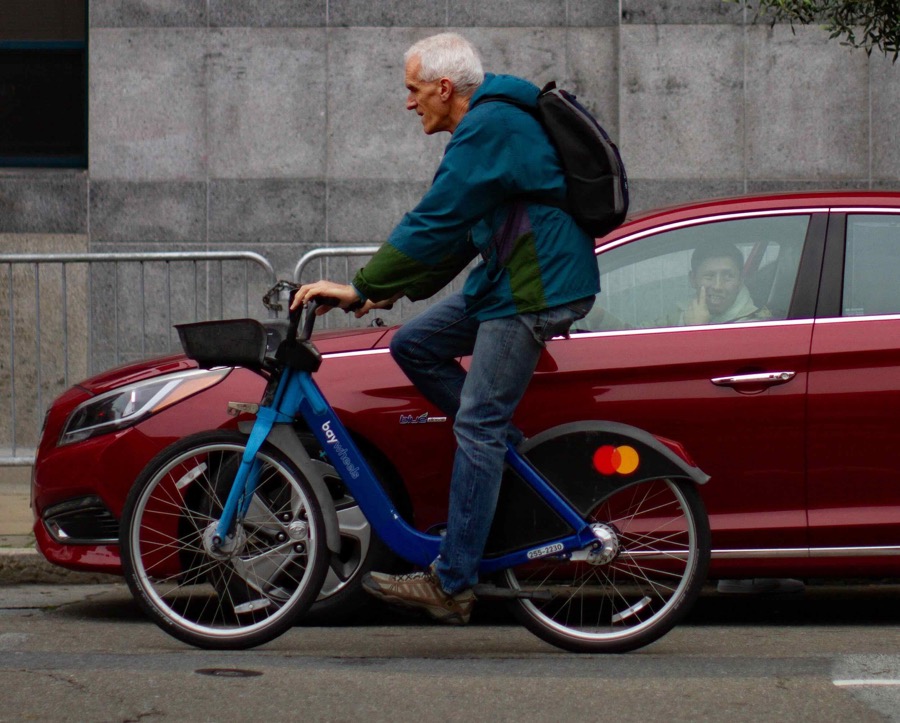
Every friction to bicycle riding discussed in this post is solved by bike share. The bike share bike sits at a dock, tire pressure fixed by the operator.
What to do about it
A few things, in rough order of impact:
Treat tire pump access as infrastructure: every bike rack at a transit station, library, school, and major employer should have a public floor pump bolted next to it. They cost a few hundred dollars.
Bundle a pump with every new bike sold: A floor pump with a gauge is $40 retail, and it takes 30 seconds to inflate bike tires. Bike shops should be offering this as a standard add-on at cost.
Teach the pump in every “learn to ride” program. 5 minutes on valve types and pump technique. Without it you are not creating independently mobile riders.
A closing thought: there are many barriers to biking that the experienced have forgotten about (gears, pumps, locks, route-finding, weather).
The infrastructure-only theory of cycling growth has us building protected bike lanes for riders who never make it out of their driveway because the back tire is at 20 PSI and the pump is buried under a recycling bin.
Enjoyed this post? Get new posts via email