Essay · TRANSPORTATION
The years Americans outlive driving

California requires drivers 70 and older to renew in person every 5 years, with a vision exam, on the premise that age makes a driver more dangerous. To check just how much more dangerous senior drivers are, I divided every fatal crash in 2017 from NHTSA’s Fatality Analysis Reporting System by the miles each age group drove in that year’s National Household Travel Survey, the most recent survey with a sample large enough to split by age.
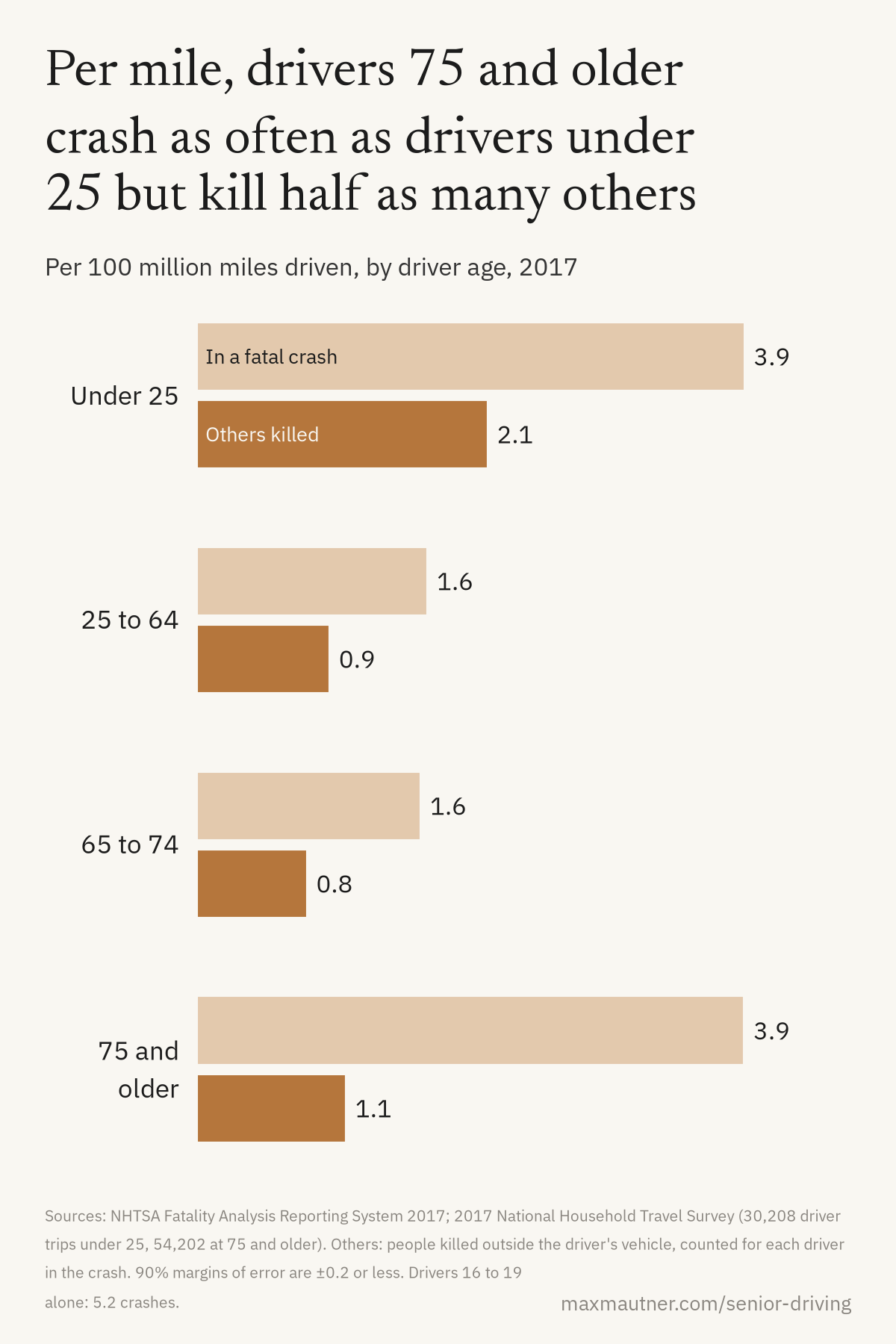
The Insurance Institute for Highway Safety attributes the oldest drivers’ high death rate mainly to fragility, the risk of dying in a given crash, which rises with age; the people at risk are mostly the drivers and their passengers.
The people killed walking, biking or riding in another vehicle are mostly killed in crashes with younger drivers: drivers under 25 were in the crashes behind ~1 in 5 of those deaths in 2017, twice their share of miles. Most Americans know someone killed in a crash, and few of those deaths involved a driver 75 or older.
Drivers who stop, whether at a renewal counter or on their own, still have years of life ahead of them, by my estimate from the same survey, the 2017 U.S. life tables and 2020 Census nursing-home counts.
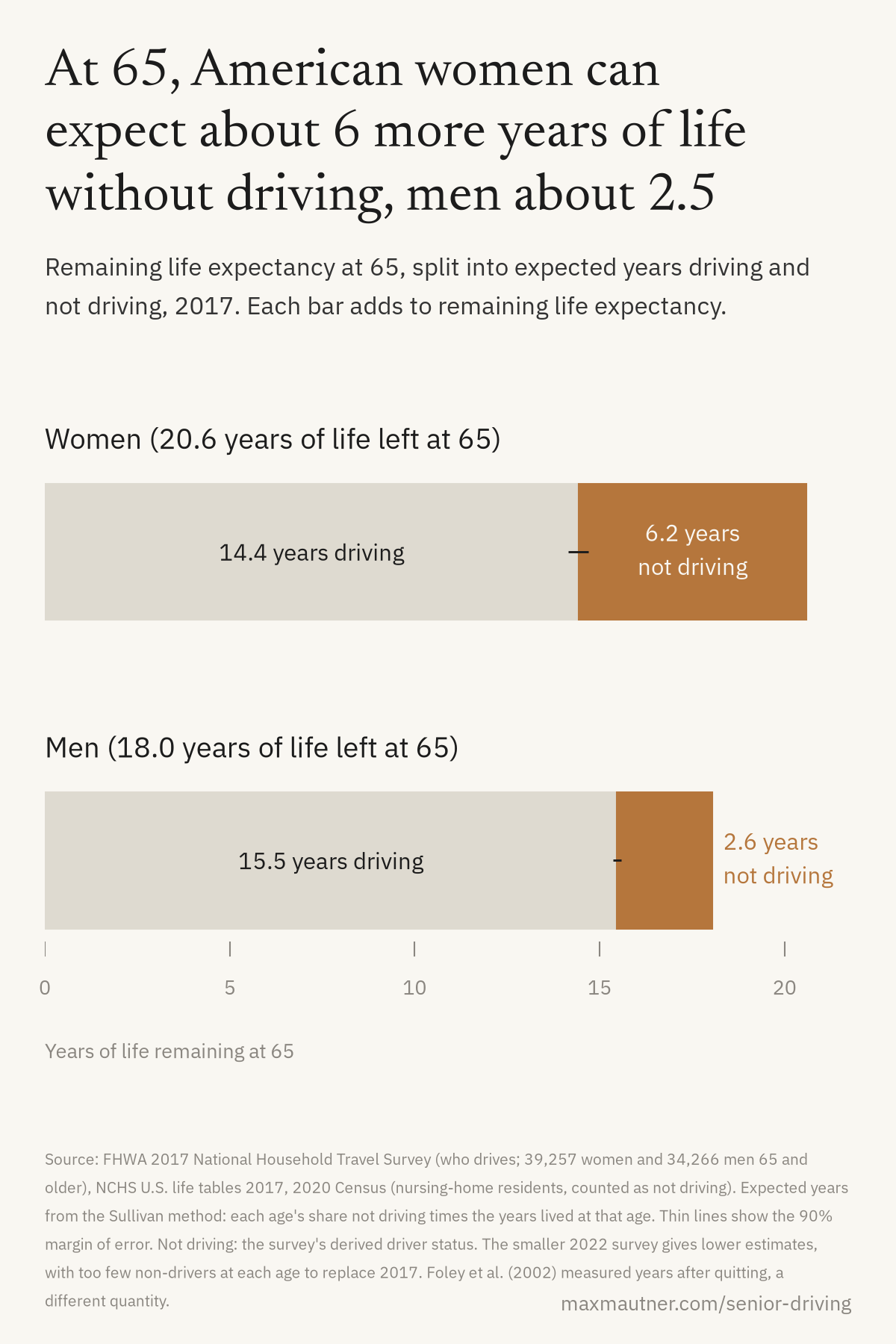
Women outlive their driving by more than men because they live longer and stop driving sooner: at 65 to 69, ~15% of women in the survey don’t drive, against ~7% of men.
In 2017, ~9.8 million Americans 65 and older didn’t drive, counting nursing-home residents. They rode with someone else on more than half their trips, and buses and trains carried ~1 in 8. In the Bay Area, seniors head more car-free households than any other group.
The charts are generated by this code, which lists every input and its source.
Enjoyed this post? Get new posts via email