Essay
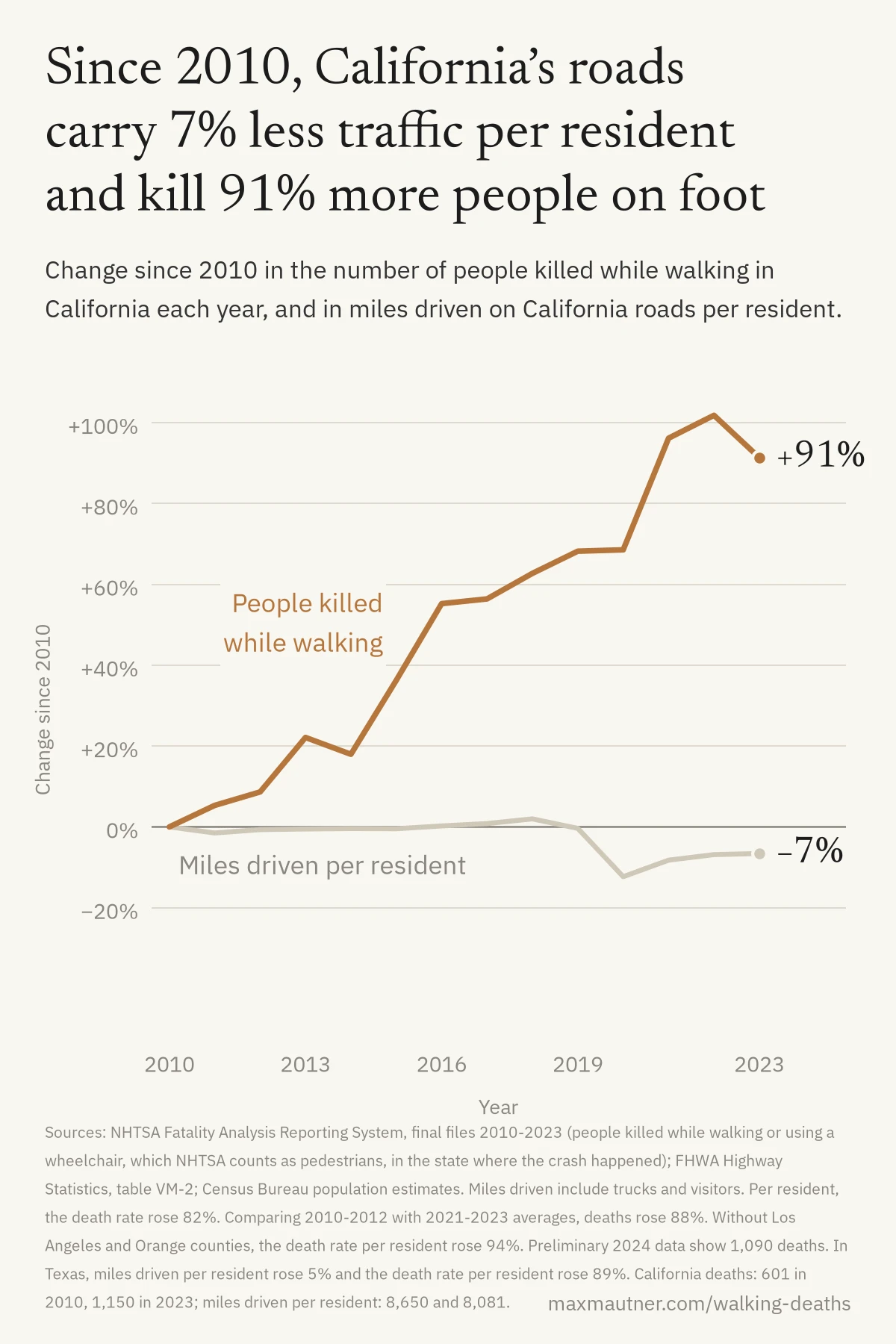
Since 2010, California's roads carry 7% less traffic per resident and kill 91% more people on foot

California’s roads carry ~7% less traffic per resident than they did in 2010, and they kill nearly twice as many people on foot. California’s population grew only ~5% from 2010 to 2023, so the death rate per resident rose 82%.
Californians walk to work ~1.6x to 1.8x as often as Texans in the Census Bureau’s commuting survey. More people on foot means more people for drivers to hit, which is why California’s death rate per resident has run above Texas’s in most years. That gap explains the difference between the 2 states, not the rise in both: the share of people walking to work barely changed in either state. Texas went the other way on driving. Per resident, its roads carried 7% more traffic than California’s in 2010 and 21% more in 2023, per federal highway data.
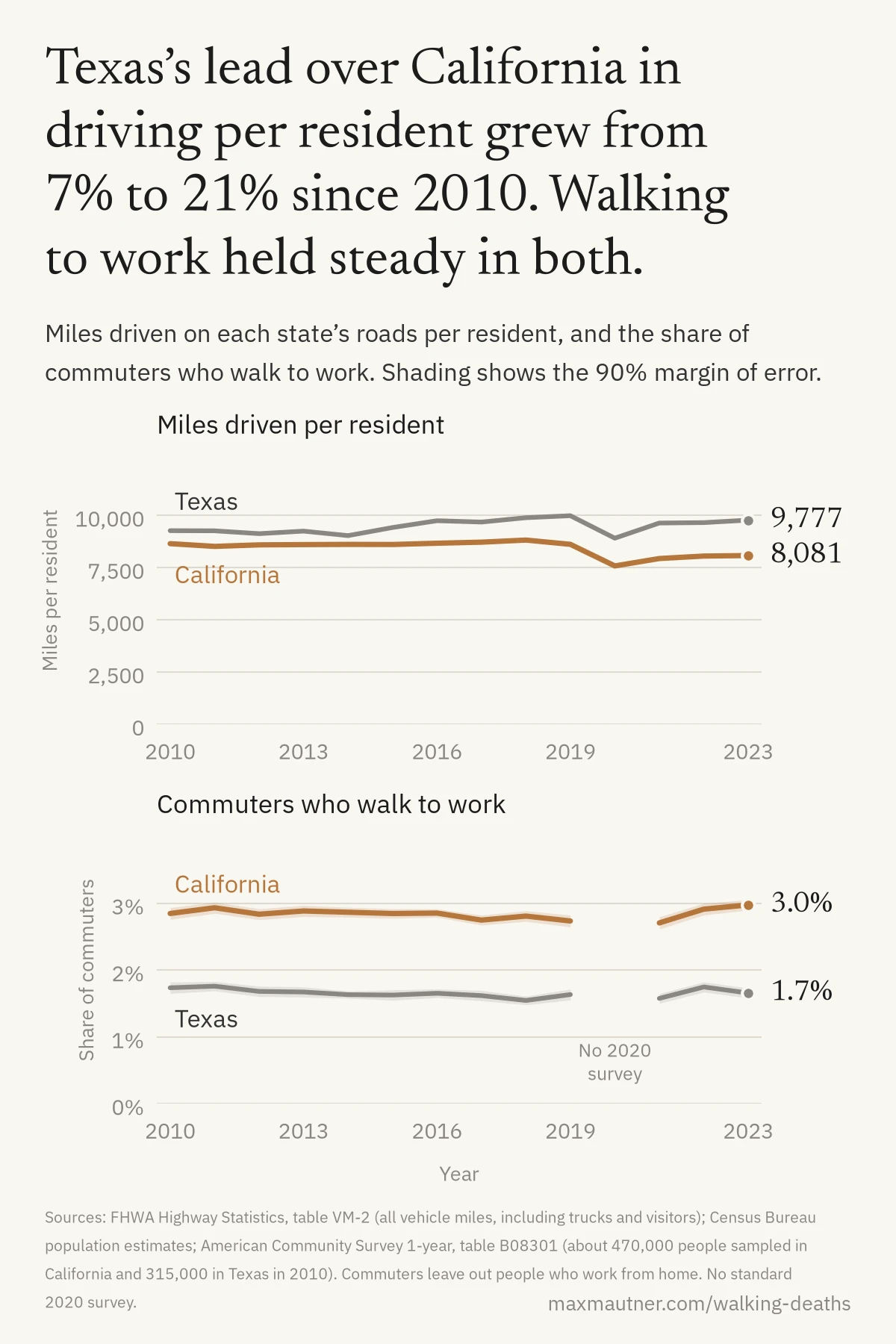
Yet the death rate of people walking rose 89% in Texas over the same years, close to California’s 82%. Driving went opposite ways in the 2 states while walking held flat in both, so neither explains the rise. These numbers can’t say what does.
The usual answer is that people on foot get themselves killed, crossing mid-block in the dark. Most of them do die that way: 81% of the people killed walking in California in 2023 were hit after dark, and 70% away from any crosswalk. People crossed mid-block at night in 2010 too, when those shares were already 71% and 64%. Deaths after dark more than doubled since then, while daylight deaths rose 25%.
Most of the deaths happen on main roads, the multi-lane streets that carry traffic across town and that people on foot have to cross. They accounted for 62% of the people killed walking in California in 2023. Main roads run by cities alone accounted for 370 deaths, more than every freeway in the state. A meta-analysis of 115 studies found that bringing a road’s average speed from 35 to 30 mph cuts fatal crashes ~33%.
Texas banned red light cameras in 2019 and bars its cities from using speed cameras. California allows speed cameras only in a pilot in 6 cities (Los Angeles, San Francisco, San Jose, Oakland, Long Beach and Glendale) that runs to 2032. San Mateo is not one of them. Around 101 of Chicago’s speed cameras, injury crashes fell ~12% below what the city’s evaluation expected without them.
A week after a student was hit in a crosswalk, San Mateo’s staff brought the City Council a proposal to raise speed limits. Residents pushed back hard in public comment, and on Sept. 22 the council set aside 15 of the increases and asked staff to bring them back at a study session. 6 weeks later, the city has not scheduled it. A city that can’t find a date to answer that kind of criticism is short on staff time, and the public comment shows residents want slower streets.
The charts are generated by this code, which lists every input and its source.
Enjoyed this post? Get new posts by email.